Moorim Paper Stock Turned Cash Positive When Capex Stopped
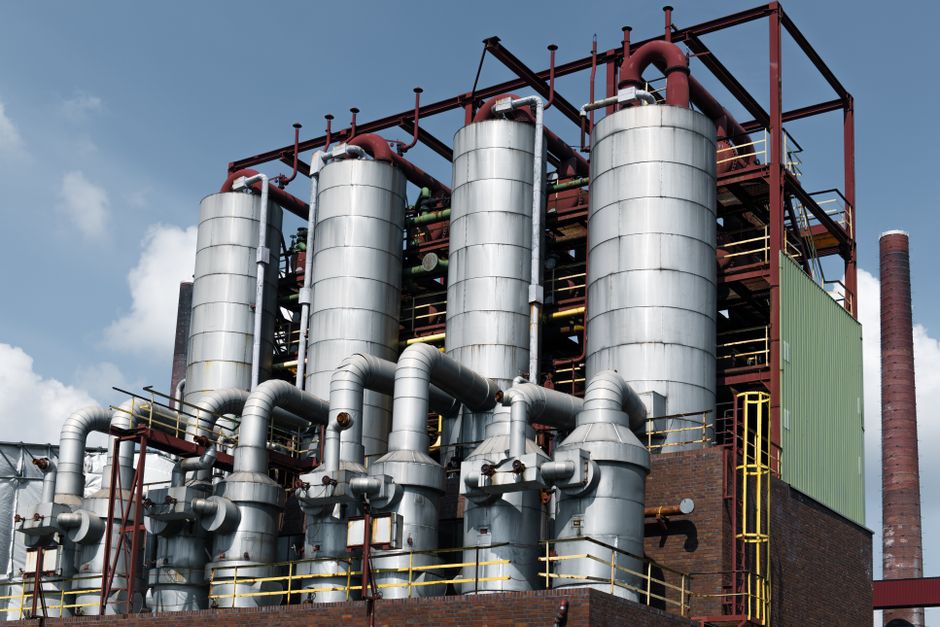
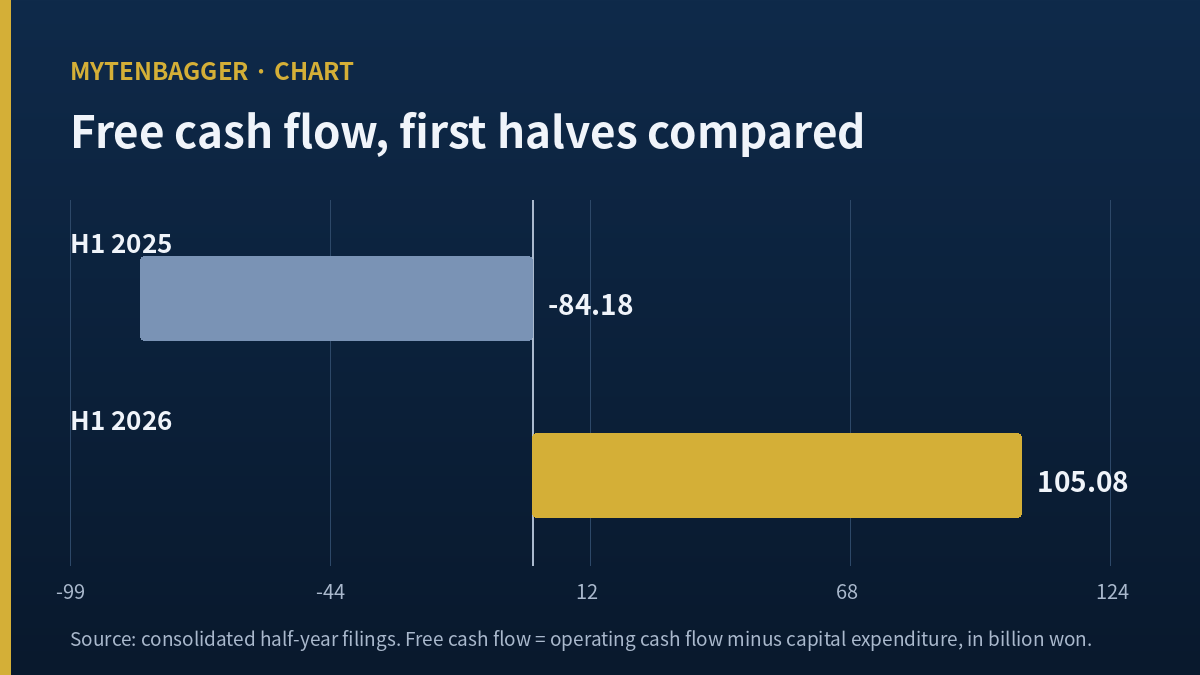
A recovery boiler at a pulp mill in Ulsan, on the southeast coast of South Korea, began commercial operation on October 23, 2025. Construction had started in 2023. I mention a piece of industrial equipment first because when I opened the cash flow statement of Moorim Paper stock, that boiler explained more of what I saw than any trading number did. In the first half of 2026 the company generated 124.67 billion won of operating cash flow and spent 19.58 billion won on capital expenditure, leaving free cash flow of 105.08 billion won, roughly 77 million dollars. One year earlier the same six months produced negative 84.18 billion won. Nothing about the paper market changed by that much. The construction ended.
Moorim Paper stock and the half-year its cash came back
What the shares cost on September 1
Moorim Paper stock trades on the KOSPI, the main board of the Korea Exchange, where the large industrial names of the country are listed. It is not a large name there. At the September 1, 2026 close of 1,542 won the market value was 64.2 billion won, about 47 million dollars, which puts it well outside the top hundred KOSPI listings by size. Foreign ownership is 1.99 percent. Price to book, using the vendor screen, is 0.15.
Fiscal 2025 revenue was 1,264.9 billion won, roughly 923 million dollars. So this is a company with close to a billion dollars of annual sales and a market value under fifty million. The gap between those two figures is the whole subject of what follows, and it does not resolve into a simple discount.
Two half-years that point opposite ways
| Six months to June 30 | 2025 | 2026 |
|---|---|---|
| Operating cash flow | 16.12bn won | 124.67bn won |
| Capital expenditure | 100.30bn won | 19.58bn won |
| Free cash flow | −84.18bn won | +105.08bn won |
| Operating profit | 14.97bn won | 28.19bn won |
| Net profit | +3.42bn won | −65.99bn won |
Consolidated figures from the Korean regulatory filing system, half-year reports filed August 14, 2026 and August 14, 2025. Korean won is the reference currency throughout.
Reading down that table, four of the five rows moved the right way and one collapsed. I want to be precise about which movement I am treating as the story. Operating profit rose 88.3 percent, and I do not lean on that, because the company credits the improvement to a weaker won and to tariff refunds after the reversal of US reciprocal duties. Both come from outside the business. The net loss is a separate matter I take up below. The row I am actually watching is capital expenditure, because it fell 80.5 percent and I can name the reason.
The boiler that reached its completion date
Korean business press reported on October 23, 2025 that a high-efficiency recovery boiler at the Ulsan mill of Moorim P&P, this company’s listed subsidiary, had been completed and entered commercial operation. Work began in 2023 and ran about two years. The company said it expects roughly 50 billion won of annual energy cost savings and payback in about seven years. Newstomato put the project cost at 280 billion won; other outlets carried no figure, so I credit that number to the single publication and do not treat it as established. The two company expectations also pull against each other. Saving 50 billion won a year and recovering the outlay in about seven years implies something closer to 350 billion won, while 280 billion won would be recovered in 5.6 years. I could not settle which figure is right, and that gap is a second reason to leave 280 billion won attributed to one outlet.
Korea Investors Service, a domestic rating agency, wrote separately that the company had been spending an average of more than 180 billion won a year on plant investment since 2023 for that boiler replacement. The annual capital expenditure line is consistent on that averaged basis: 176.01 billion won in 2024, 187.36 billion won in 2025, then 19.58 billion won for the first six months of 2026.
So the cash did not come back because the paper business got better. It came back because a two-year construction program reached its end and the outflow that had been eating every won of operating cash simply was not there anymore. I find that a cleaner explanation than most of what I read about this sector, and it also sets a limit on how far I can extend it. A project that ends once does not end twice.
Where the operating profit came from
Segment figures reported by the Korean trade outlet EBN on August 31, 2026 break the first-half operating result into five pieces: paper 1.86 billion won, distribution 18.5 billion won, finance 8.1 billion won, pulp negative 9.3 billion won, and other 10.0 billion won. The paper segment fell 92.5 percent from 24.85 billion won a year earlier.
Those five add to 29.16 billion won against a consolidated operating profit of 28.19 billion won, a gap of 0.97 billion won that I assume is intersegment elimination. I could not see the reconciliation table, so I am flagging the difference instead of explaining it away. Either way the direction holds. In a company whose name is Paper, the printing paper operation earned under two billion won in six months while distribution and finance earned 26.6 billion won between them.
The line that turned the half-year red
The consolidated net loss for the six months was 65.99 billion won, against a 3.42 billion won profit a year earlier. The company named the cause in its August 14, 2026 results announcement, carried by Edaily: a non-operating charge of 86.13 billion won related to a Korea Fair Trade Commission penalty.
On April 23, 2026 the commission fined six paper companies a combined 338.33 billion won for fixing printing paper prices between February 2021 and December 2024. Korean press coverage described more than sixty meetings and seven agreed price increases, with printing paper prices rising an average of 71 percent over the period. The same coverage reported that two of the six were referred to prosecutors and that all six were ordered to set their prices independently.
Three sources that agree inside 0.15 percent
The 86.13 billion won charge did not match any single disclosed fine, which is why I spent time on it. Moorim Paper’s own penalty was 45.85 billion won. Its subsidiary Moorim P&P, which it owns 66.97 percent of and therefore consolidates in full, was fined 91.96 billion won. Those two add to 137.80 billion won, leaving 51.67 billion won unaccounted for.
A second filing closed the gap. On June 12, 2026 the amounts were amended: Moorim Paper to 28.6 billion won and Moorim P&P to 57.4 billion won, per Herald Business. Those two sum to 86.0 billion won. The half-year report carries 86.13 billion won. The difference is 0.13 billion won, about 0.15 percent of the total. A Korea Economic Daily article dated August 13, 2026 described the reduction for the Moorim companies as roughly 51.7 billion won, which reconciles from the other end. Working from the amended figures the reduction is 51.80 billion won, so the reported number is rounded by about a tenth of a billion.
Half-year non-operating charge: 86.13bn won gives a difference of 0.13bn won
Cross-check from the other direction: 137.80bn less the reported 51.7bn reduction gives 86.10bn won
Two filings by the company and press coverage of those filings land within 0.15 percent of each other. Calling that three sources overstates it, since one party produced two of the three, and an accrual that matches a confirmed penalty is arithmetic, so it corroborates nothing by itself. It does establish what the charge is. Two caveats survive. The parent company Moorim SP was fined 0.35 billion won and sits outside this consolidation, so it is not in the sum. And no publication I found explained why the amounts were cut; the filing language says only that it reflects notification of the commission’s decision. I know the outcome and not the reason.
One more comparison belongs here, because it is where I met this company before. In the same enforcement action Hansol Paper’s 142.58 billion won fine was waived entirely. I wrote about that company in August, and at the time Moorim Paper was one row in a domestic comparison table I built there, a measuring point for how much better Hansol was doing. Reading the same company as the subject instead of as a row changes the question that attaches to it. There it was evidence that only one of four Korean paper firms was profitable. Here the question is whether the losses came from operations, and the answer is that they did not.
The subtraction does not reach the reported loss
Before going further I owe a check. Take first-half operating profit of 28.19 billion won, subtract interest expense of 48.25 billion won and the 86.13 billion won charge, and the arithmetic gives negative 106.19 billion won. The reported net loss is 65.99 billion won. Something worth 40.20 billion won came in from the other direction.
Fiscal 2025 has the same shape. Operating profit of 5.95 billion won less interest of 73.12 billion won gives negative 67.17 billion won against a reported net loss of 23.24 billion won, leaving 43.93 billion won unaccounted for.
I have not decomposed either figure. Non-operating income and tax effects will be in there, and this company runs a finance segment that earned 8.1 billion won in the half, so financial income is part of it too. What I can say is that the sentence “interest and a fine turned an operating profit into a loss” is a summary with two terms missing. Calculated that way the loss comes out 2.9 times too large for 2025 and 1.6 times too large for the first half of 2026. I am writing about the size of these two charges, and not claiming they account for the whole loss.
Interest is the other number above the market value
Fiscal 2025 consolidated interest expense was 73.12 billion won, about 53 million dollars, against operating profit of 5.95 billion won in the same year. The interest bill was larger than the entire market value of the company at the September 1, 2026 close. For the first half of 2026 interest was 48.25 billion won against operating profit of 28.19 billion won.
I should note a conflict. Korea Investors Service, when it moved the outlook on the company’s unsecured bonds to negative in early April 2026 while holding the rating at A minus, described interest expense as exceeding 40 billion won. The consolidated filing figure is 73.12 billion won. The difference may come from a parent-only basis or from a net interest measure; I could not open the underlying report to settle it. Every interest figure in this piece is consolidated.
The dividend, and what it is measured against
The board declared a full-year dividend of 125 won per share on February 20, 2026, totaling 5.20 billion won, about 3.8 million dollars. Shareholders approved it on March 24, 2026. The dividend has risen four years running: 25 won for 2021, then 50, 75, 100 and 125.
The yield depends entirely on which price you divide by. The company’s own disclosed yield, calculated on an average price of 1,983 won, was 6.3 percent. Against the September 1, 2026 close of 1,542 won the same 125 won gives 8.11 percent. The share price fell 22.24 percent between those two price bases. The extra 1.81 percentage points of yield came from the price, and I want to know that before deciding whether an eight percent number is attractive.
Set the three outflows against the same 64.2 billion won market value and the structure of this business becomes visible in one line. Shareholders received 8.1 percent of it. Lenders received 113.9 percent of it in a single fiscal year. The competition authority received 134.2 percent of it in six months.
Leverage got worse while cash improved
At June 30, 2026 total liabilities were 2,069.7 billion won against equity of 620.9 billion won, a ratio of 333.36 percent, up from 270.59 percent at the end of 2025. Equity fell because of the half-year loss. Total assets were 2,690.6 billion won.
Korea Investors Service put borrowing dependence at 61.1 percent and gross debt to EBITDA at 16.5 times on 2025 year-end figures, with EBITDA falling from 184.4 billion won in 2024 to 95.5 billion won in 2025. I could not find a disclosed total borrowings figure as of June 2026, so I cannot describe the maturity profile.
A US subsidiary with thin equity
MOORIM USA, wholly owned, posted first-half revenue of 147.33 billion won and net profit of 18.86 billion won, against a 5.23 billion won loss a year earlier. That is a real turn. But at June 30, 2026 the entity held assets of 102.22 billion won against liabilities of 94.42 billion won, leaving equity of 7.81 billion won and a liabilities-to-equity ratio near 1,210 percent. At the end of 2025 that equity figure was negative 11.0 billion won. The subsidiary climbed out of a capital deficit during the half, and it is standing on a very narrow base.
The European subsidiary follows the same pattern
The European entity is smaller and follows the same outline. Revenue for the half came to 50.88 billion won, up 17.4 percent, on net profit of 0.39 billion won against 0.11 billion won a year earlier. Its equity at the end of June was 2.47 billion won, roughly one won of equity for every fifteen won it owed. Both overseas figures come from EBN reporting dated September 1, 2026, and not from filings I opened myself.
Sorting paper companies by a threshold instead of a margin
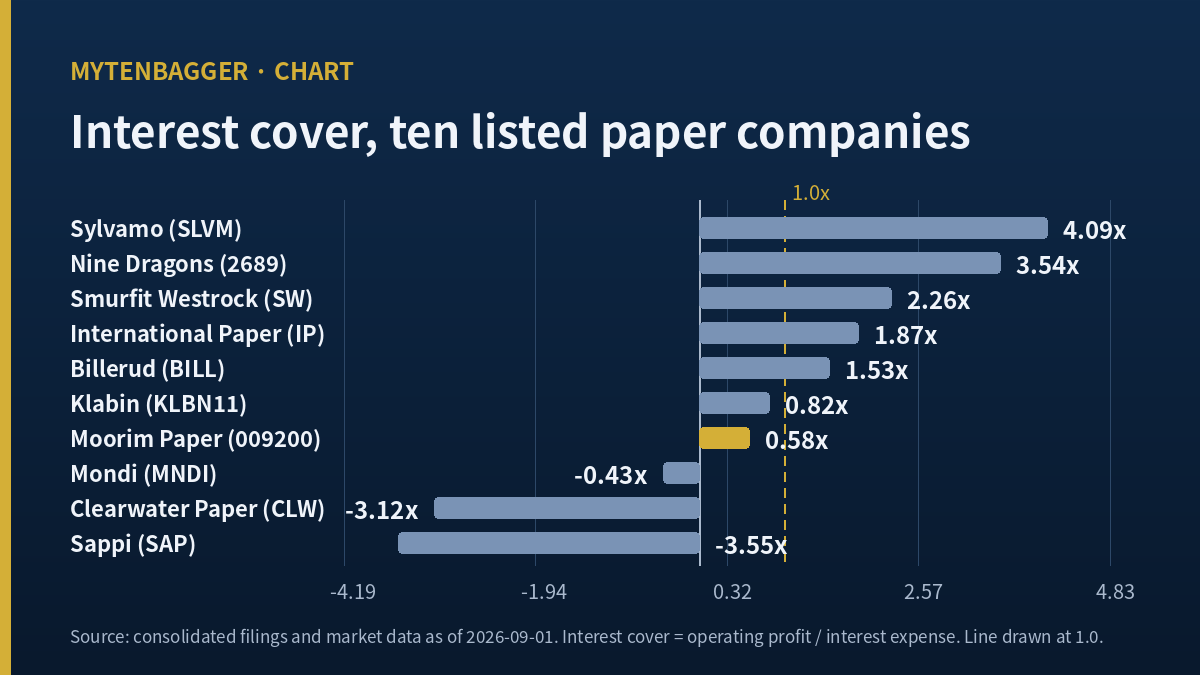
For the peer comparison I did something different from what I usually do. Instead of ranking global paper companies by operating margin, I drew one line, whether trailing operating profit covers interest expense at all, and split the table into the side above one times and the side below it.
Splitting a peer table on one line rather than ranking it has a cost worth naming: it can put a company on the good side of the line and leave the market unconvinced. Insun ENT carries an operating margin close to Clean Harbors while the market prices it near Enviri, which is the same table read twice and answered twice. I keep that case beside this one as a reminder that the line I draw is my line, not the market’s.
| Company | Interest cover | Operating margin | Debt / equity |
|---|---|---|---|
| Above one times | |||
| Sylvamo (NYSE SLVM) | 4.09 | 5.82% | 1.08 |
| Nine Dragons (HKG 2689) | 3.54 | 8.63% | 1.43 |
| Smurfit Westrock (NYSE SW) | 2.26 | 6.09% | 0.78 |
| International Paper (NYSE IP) | 1.87 | 4.15% | 0.69 |
| Billerud (STO BILL) | 1.53 | 0.82% | 0.29 |
| Below one times | |||
| Klabin (BVMF KLBN11) | 0.82 | 10.02% | 2.30 |
| Moorim Paper (KRX 009200) | 0.58 | 4.37% | 3.33 |
| Mondi (LON MNDI) | −0.43 | −0.70% | 0.56 |
| Clearwater Paper (NYSE CLW) | −3.12 | −4.51% | 0.47 |
| Sappi (JSE SAP) | −3.55 | −8.44% | 1.24 |
Peer figures from stockanalysis.com, mostly trailing twelve months to June 30, 2026. Billerud’s data runs to March 31, 2026 and Nine Dragons’ to December 31, 2025, so those two rows are staler than the rest. The Moorim Paper row is not on the same basis as the peer rows: it uses first-half 2026 consolidated filings, and on fiscal 2025 full-year figures its interest cover would be 0.08 and its operating margin 0.47 percent. The 3.33 figure is total liabilities over equity, shown because no debt-only figure was disclosed; it is not directly comparable with the peer column. No currency conversion is applied to this table; only ratios are compared.
What the threshold table does not settle
The ordering that comes out of this is not the ordering a margin table produces. Klabin runs a 10.02 percent operating margin and still fails the test. Billerud runs 0.82 percent and passes it. On the half-year basis, between Klabin at 0.82 times and this company at 0.58 times there is no other row. On the fiscal 2025 basis this company would sit at 0.08 and the ordering below the line would look nothing like it does here, which is why I am reporting the basis alongside the number. That is the comparison I take away, and it says nothing about which business is better run. It does tell me which box Moorim Paper stock sits in.
There is also a structural point sitting under the table. None of the nine peers in that table discloses uncoated freesheet or graphic paper as a reportable segment, and Moorim Paper itself does report a paper segment, so the pattern belongs to the peers. Sylvamo does not need to, because that is essentially all it makes; it was spun out of International Paper on October 1, 2021 carrying the printing papers business. Mondi folded its Uncoated Fine Paper segment into packaging on October 1, 2025 and stopped reporting it separately, per its own full-year results announcement. UPM and Sappi signed a definitive agreement in May 2026 to combine their European graphic paper operations into a single venture, and trade press reported that the European Commission issued a statement of objections against that deal on August 26, 2026. International Paper converted a machine at Selma, Alabama away from uncoated freesheet, removing what Sylvamo described as about seven percent of North American supply.
The industry is walking away from the product this company still makes. Whether that leaves the remaining producers with better pricing or a shrinking end market is exactly the question I cannot answer from a filing.
Nobody has published an estimate since 2015
Looking for forward estimates, I came back with nothing. The most recent brokerage report listed on the Korean disclosure aggregator is dated July 3, 2015. The vendor database fields for forward earnings per share, forward price to earnings and peer multiples are all empty.
This is different from failing to find something. Eleven years without a published estimate is itself a fact about the security. There is no table of analyst valuations in this piece because there are no figures to print in one.
A rating agency is the only outside opinion left
What does exist is a credit view. That outlook change, mentioned above, rested on weaker profitability from soft pulp prices, lower exports and rising costs. Coverage of that action appeared in Energy Economy on April 9, 2026.
The asymmetry seems logical to me. In three of the last four fiscal years, per the consolidated filings, interest expense exceeded operating profit: 74.9 billion won against 67.8 billion in 2023, 91.5 against 89.4 in 2024, and 73.1 against 6.0 in 2025. The exception was 2022, at 95.2 against 96.3. When that is the pattern, the first question about the business is whether it can service its debt, and the people who ask that question professionally are bondholders.
Where the price has been
Across the trailing 250 trading sessions the closing high was 2,560 won on April 16, 2026 and the closing low was 1,256 won on June 26, 2026. The September 1, 2026 close of 1,542 won sits 39.77 percent below that high and 22.77 percent above that low.
The vendor screen shows a 250-day high of 2,685 won and labels it as adjusted closing data, but when I pulled 270 daily bars and sorted them, 2,685 was that day’s intraday high and the close was 2,560. The drawdown differs by 2.80 percentage points between the two bases. I used the closing series so the fall matches the price in my tables. The low of 1,256 is identical on both bases.
Eight things that would make this piece wrong
One. The 105.08 billion won free cash flow covers six months in which capital expenditure was unusually low; the full 2025 year produced negative 168. A half-year capex line read against the prior year is the same measurement I ran in Sungkwang Bend, whose half-year capex was 1.6% of the prior year.39 billion won, and annualizing the half reverses the conclusion. Two. I could not decompose the 190.6 billion won difference between operating cash flow and the net loss into its components. Depreciation is large in this industry and the antitrust charge may be recognized on a different timetable from any cash payment, but that is the extent of what I know. Three. Reading the capital expenditure drop as project completion is my inference; the company announced a completion; it announced no spending cut.
Four. The 280 billion won project cost appears in one outlet only. Five. The 86.13 billion won reconciliation rests on press reporting of two filings, and two further amendments to the penalty disclosure, dated July 24 and August 28, 2026, are ones I have not read. Six. Segment operating profit comes from a trade publication and the five components miss the consolidated total by 0.97 billion won. Seven. Non-controlling interests are 238.1 billion won of the 620.9 billion won consolidated equity, so 38.3 percent of every consolidated figure here belongs to the minority holders of the listed subsidiary. Eight. Korean publishers were reported on June 30, 2026 to be preparing damages claims against all six fined companies, a civil exposure separate from the penalty and one I cannot size.
One thing I checked that held
Share count came out clean, which surprised me given how often it does not. Paid-in capital of 104,023,275,000 won divided by the 2,500 won par value gives 41,609,310 shares. The declared dividend total of 5,201,163,750 won divided by 125 won per share gives the identical 41,609,310. Book value per share on the vendor screen, 10,373 won, equals 2025 year-end controlling equity of 431.61 billion won divided by that same share count. Earnings per share of negative 369 won equals the controlling net loss of 15.36 billion won on the same base.
The screen’s own shares-outstanding field reads 41,634,241, which is 24,931 higher and does not reconcile with paid-in capital. Whether that gap is treasury stock I could not confirm. It moves the market value by 0.06 percent, so nothing in this piece turns on it.
The boiler changed the order I read things in
The boiler is the part of this I keep thinking about, and not for what it does to margins. I opened this company expecting to write about a distressed balance sheet with a high dividend attached, which is what the screening fields advertise. The cash flow statement said something else, and the explanation was a completion date in a construction timetable.
The order I usually read in puts the income statement first and the cash flow statement somewhere near the end, usually after I have already formed a view. Here that order would have produced the wrong piece. A company can look worse in every income line and better in every cash line at the same time, and which of those is the temporary condition depends on facts that are not in either statement. I have read the capital expenditure line first on every filing I have opened since.
What I will do, and the date I will do it
I do not own Moorim Paper stock and I have no order in. At a 64.2 billion won market value this stays an observation record for me.
My reason for staying out is not the price. At 0.15 times book with an eight percent trailing yield I could not call this expensive. My reason is the ordering of the outflows. Eight percent of the market value goes to shareholders and 113.9 percent of it goes to lenders, and until those two lines change places I do not know what cheap is supposed to mean here.
So this time I am writing down what I will do when the condition resolves, alongside the condition itself. Writing only the trigger has let me answer a met trigger with more waiting.
Condition two, and I act. In the same report, if nine-month operating profit exceeds nine-month interest expense and quarterly capital expenditure stays under 10 billion won in the third quarter as well, I reclassify this from a loss-making dividend payer to a company that has finished building, and I move it onto my active watch list. What happens after that is a separate decision I am not writing here.
When these expire. Both conditions lapse when the full 2026 annual report appears in March 2027. After that I re-measure with a single annual pair, operating profit against interest expense for the full year, because cumulative quarters move with seasonality I have not yet learned for this company.
Sources · Edaily first-half results · EBN segment breakdown · EBN overseas subsidiaries · Ajunews on the antitrust decision · Herald Business on the amended fines · Energy Economy on the ratings outlook · Korea Economic Daily on the Ulsan boiler · Hankook Ilbo on publisher damages claims · Sylvamo financials · International Paper on the Sylvamo spin-off · Korean-language coverage is cited as such; consolidated financial figures come from the company’s regulatory filings.