HD Hyundai Heavy Industries Stock: I Bought the 32% Drop
- HD Hyundai Heavy Industries stock fell about 32% in a month to roughly ₩472,500 ($342), and I started scaling into that drop.
- My reasons: a Q2 operating profit that Korean sell-side pegs near the ₩1 trillion ($730M) mark, an order book worth about 3.5 years of work, and two side bets — US Navy repair work and engines for AI data centers.
- My line in the sand is just as clear: at 5.28x book this is not a cheap stock, and if the Qatar LNG delivery delay drags on, my thesis wobbles.
The spreadsheet I reopened last week had nothing to do with HD Hyundai Heavy Industries stock at first. I pulled up my shipbuilder delivery schedule because a Qatar LNG terminal had gone offline, and I wanted to know how that rippled into Korean yards. Then the quote window next to it caught my eye: this name was down about 32% in a single month. A company walking into its strongest profit in three years, and the stock was bleeding. That mismatch is where I start this journal. (All figures use a rough exchange rate of ₩1,380 per US dollar; I round the conversions.)
Let me put my cards down first. I began scaling into this name in mid-July, in the ₩472,500 ($342) area. I did not buy it because it is cheap — on the multiples it is not. I bought it because earnings are rising while the price is falling, and that particular gap is the kind I like to lean into. I will hold both of those truths in the same journal, because a one-sided entry is a data gap, not a stance.
Contents
Where HD Hyundai Heavy Industries stock sits after a 32% month
First, some orientation for readers outside Korea. HD Hyundai Heavy Industries stock trades on the KOSPI — the main board of the Korea Exchange (KRX), the larger of Korea’s two markets, with the tech-heavy KOSDAQ as the junior board. As of July 15, 2026 the shares changed hands near ₩472,500 ($342), for a market value of roughly ₩49 trillion ($35.5 billion), which places it around 13th by size on the KOSPI (Kiwoom Securities data). There are about 105 million shares out.
The trouble is the trajectory. The stock is down about 32% over one month, roughly 8% over three months, and 23% over six (Kiwoom price data). Its 52-week high was ₩765,000 ($554), so I am buying about 38% below that peak. The price is below both its 20-day and 60-day moving averages. On the tape, the trend is broken, and I will not pretend otherwise. What I am doing here is not confirming an uptrend and climbing aboard; it is catching a falling knife in slices. Different trade, different risk, and I want that on the record.
Three reasons I bought HD Hyundai Heavy Industries stock into the drop
Reason one: earnings are inflecting right now
What I weighed most is the direction of profit. On a trailing-twelve-month basis the company shows revenue near ₩17.6 trillion ($12.8B), operating profit near ₩2.04 trillion ($1.48B), and an operating margin around 11.6% (Kiwoom financial data). The line that jumps out is the growth rate: operating profit up roughly 189% year on year, while revenue grew about 21%. Profit tripling on a fifth more revenue is textbook operating leverage — the moment when a yard burns off its old low-price backlog and higher-priced ships start hitting the income statement. Its three-year revenue compound growth rate sits near 24.8% (Kiwoom), so top line and profit are expanding together.
And this gets tested again within weeks. In its July 3 note, Korea Investment & Securities estimated Q2 2026 consolidated revenue of ₩6.33 trillion ($4.6B) and operating profit of ₩1.008 trillion ($730M) — up about 114% year on year, at a 15.9% margin. I am careful here: that is a brokerage estimate, not a company-confirmed figure. But if a quarterly operating profit near ₩1 trillion actually prints, this yard is demonstrating a roughly ₩4 trillion annual earnings engine. I treat the late-July Q2 print as my first checkpoint on this trade.
Reason two: the order book is about 3.5 years deep
In a shipbuilder, the thing I read before earnings is the order backlog. Profit is just work already booked being recognized as revenue, so a thick backlog is years of sales already reserved. Korean yards entered 2026 with roughly 3.5 years of work in hand, and trade-press reporting through this year has described continued LNG-carrier and very-large ammonia-carrier (VLAC) orders bringing advance payments in. Korea reclaimed about 20% of global shipbuilding share as China’s volume dominance cooled, according to Korean and maritime press.
Why the backlog matters to me is downside support. Even if new orders go quiet for a spell, the stack already booked carries revenue for years. It is not a guarantee the stock rises — the market watches “are next quarter’s new orders slowing” before it watches the backlog. So I treat the backlog as a reason to feel safe holding, not as a trigger to expect a rally. I keep those two ideas apart when I size the position.
Reason three: engines and naval work, the cards outside shipbuilding
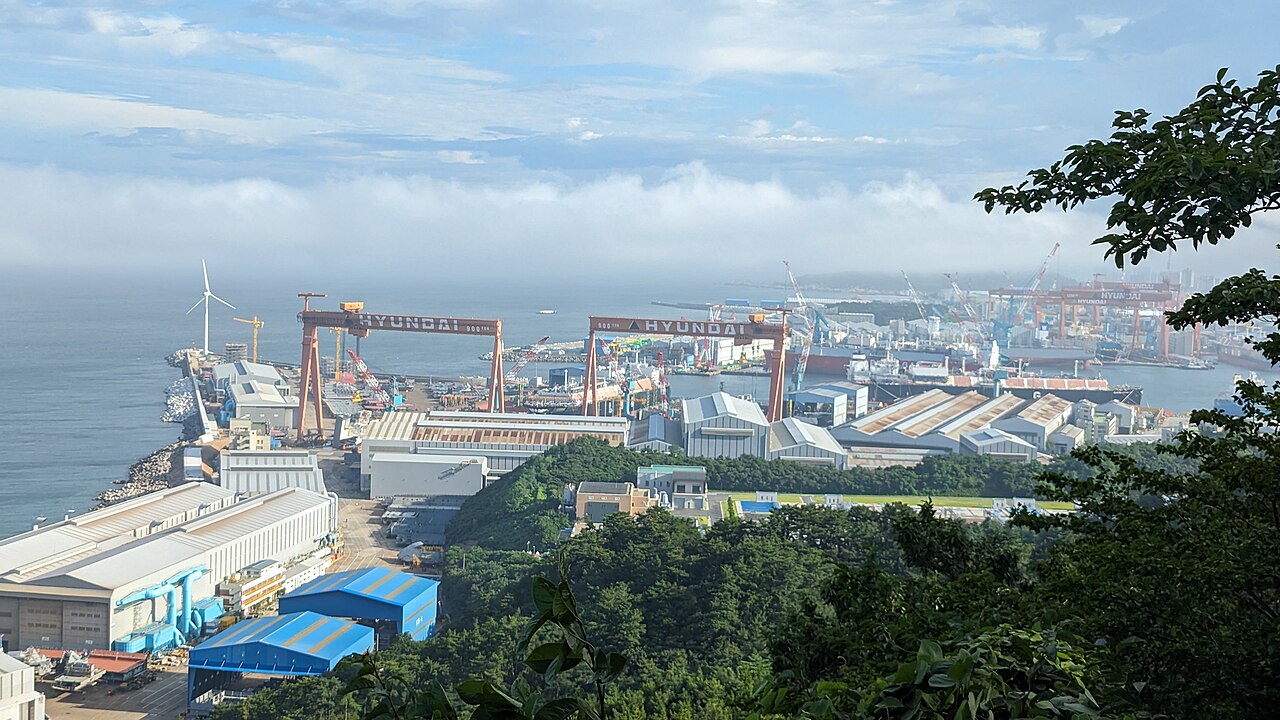
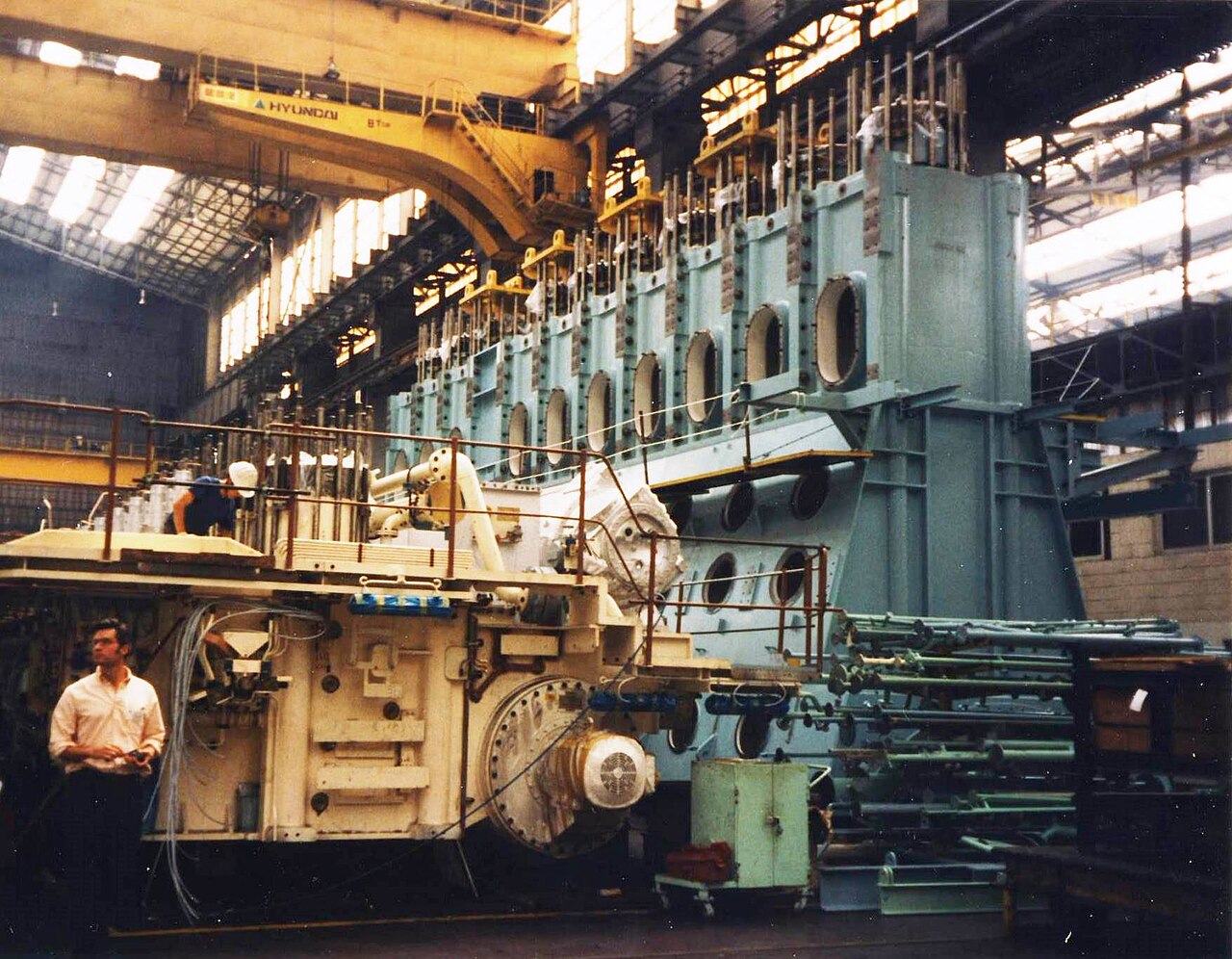
The third piece sits outside the core yard. The company decided to expand a medium-speed engine plant on about 3,500 square meters of idle land at its Ulsan yard. Per the Korea Investment & Securities note, the line can build around 200 units a year of 2-megawatt-class medium-speed engines, and one target market is onshore power generation for AI data centers. The group also runs a separately listed pure engine maker — I covered that cycle in my HD Hyundai Marine Engine journal. A maker of ship engines widening into the power-starved data-center world is exactly the kind of optionality I do not get to underwrite often.
Bolt on the naval side. HD Hyundai Heavy Industries won additional US Navy vessel maintenance, repair and overhaul (MRO) work in 2026. Korean press describes Korean yards’ US Navy MRO awards rising sharply, with this company and Hanwha Ocean splitting the volume; the yard has already completed a first Navy support-vessel contract and taken on follow-on work. I do not model MRO as a near-term profit driver — the scale is still small, and a single support-ship overhaul does not move a ₩49 trillion company. But as a foothold in the US commercial and naval market, this is revenue that survives even if the shipbuilding cycle cools, and it comes with a customer that does not shop on price alone. What I bought is that direction of travel.
HD Hyundai Heavy Industries stock: the numbers, cheap and not
Having laid out my reasons to buy, I put the expensive side on the same table. An honest journal shows the bull case and the rich price on one screen.
| Metric | Value | How I read it |
|---|---|---|
| Price (2026-07-15) | ₩472,500 ($342) | -32% in a month, -38% from high |
| Market cap | ~₩49T ($35.5B) | ~13th on the KOSPI |
| Operating profit (TTM) | ~₩2.04T ($1.48B) | +189% YoY, operating leverage |
| Operating margin | 11.6% | Q2 est. 15.9% (KIS) |
| P/E (TTM) | ~30x | not a value screen |
| P/B | ~5.28x | high for a shipbuilder |
| ROE | 18.8% | partly justifies the P/B |
| Foreign ownership | 13.9% | one leg of the flows |
Sources: Kiwoom Securities financial and price data (as of 2026-07-15); Q2 estimates from Korea Investment & Securities, July 3, 2026.
Read this way, my purchase looks a little exposed. A 5.28x price-to-book and a 30x price-to-earnings are not value-stock numbers by any yardstick. In a cyclical business like shipbuilding, 5x book is historically near the top of the range. What I hold onto is the 18.8% return on equity: a company earning that much on its capital can carry a higher book multiple, at least in part. The open question is whether that ROE is a cycle-peak flash or a durable few-year engine. I leaned slightly toward the latter — and I say “slightly” because I am not fully settled on it. Building the table, my hand paused once.
One more line I checked outside the table: the dividend. The company’s fiscal-2025 dividend was ₩5,661 ($4.10) per share, up nearly threefold from ₩2,090 ($1.51) the year before (per Korean regulatory filings). That is about a 1.1% yield at today’s price, on a payout ratio near 36%. The absolute yield is modest. What I liked is the direction: profit is rising and the return of capital is rising with it, unlike the old shipbuilding cycles where earnings spiked and shareholders saw nothing. That is a reason to hold through noise, more than a reason for the stock to climb.
There is an old memory tugging at me here, and it belongs in an honest journal. Years ago I filed Korean shipbuilders under “perpetually low-ROE” and stopped looking — flashy order wins, nothing left at the bottom line, or so I assumed. I was slow to notice this industry’s return on equity climbing into the high teens. That miss is roughly half of why I am buying now: I do not want to make the same dismissive call twice, and an 18.8% ROE is precisely the number my old bias told me shipbuilders could never post. Owning that mistake in writing is part of why I keep this journal at all.
How HD Hyundai Heavy Industries stock stacks up against global yards
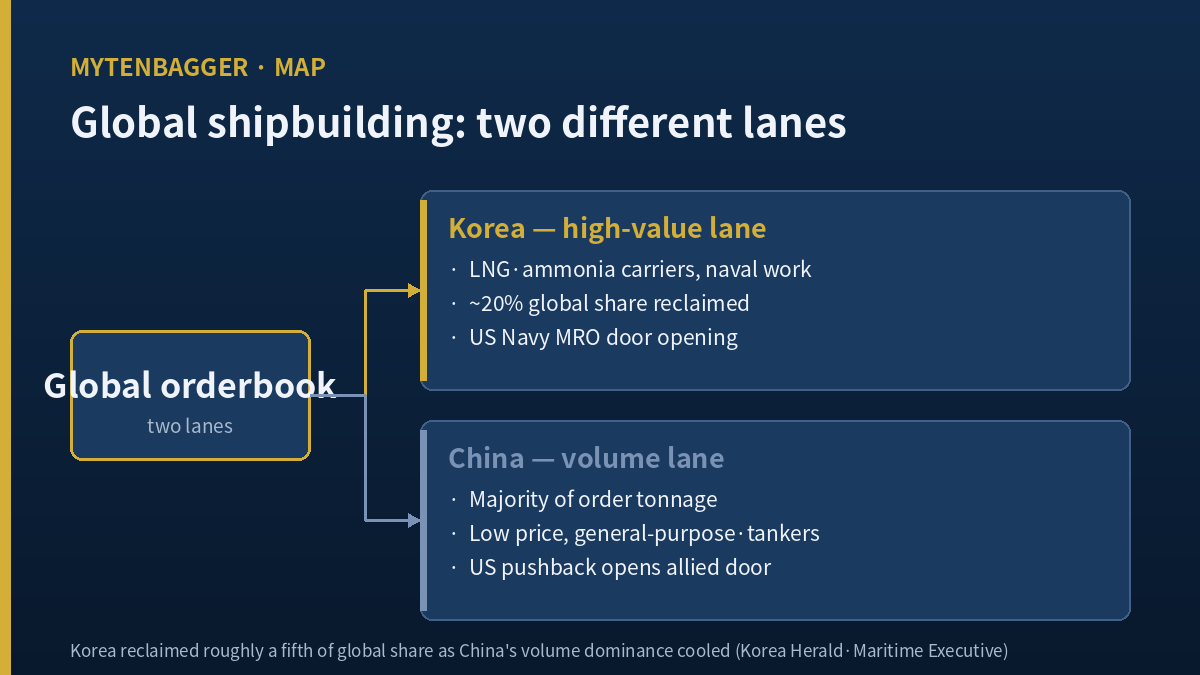
For US readers, the global frame matters more than a single Korean multiple. The shipbuilding world has split into lanes. China’s yards took the majority of global order volume through 2024 and 2025 on low prices, dominating general-purpose and tanker work. Korea’s yards ceded that volume race but kept the high-value lane — LNG carriers, ammonia carriers, and strategically sensitive vessels — and clawed back roughly a fifth of global share as China’s dominance cooled (Korea Herald; Maritime Executive). Japan’s yards, meanwhile, have shrunk their merchant footprint.
That lane split is my real peer comparison, and it is why I did not go hunting for a single foreign name to price this against. A Chinese state yard and a Korean high-value yard are not the same business, and I will not pin an overseas price-to-earnings I cannot verify onto this journal. What I can verify is the structural picture: the US wants commercial and naval shipbuilding capacity it no longer has at home, Washington’s push against Chinese yards has opened a door for allied builders, and Korean yards are walking through it — Hanwha Ocean via its US shipyard purchase, HD Hyundai Heavy Industries via Navy MRO. For a US investor, that is the cleanest way to see where this name fits: the high-value, US-aligned corner of a global industry China dominates by tonnage.
Three ways I see HD Hyundai Heavy Industries stock playing out
My base case (about 50%)
Q2 operating profit prints near the sell-side estimate, around the ₩1 trillion mark, and new LNG and ammonia-carrier orders keep coming in the back half. The market sets aside the “cycle peak” fear for a while and re-reads the earnings power. In that path I see the shares trying to retrace toward their pre-selloff zone. This is my base — the path the data supports best.
Where I could be wrong (about 35%)
The Qatar LNG situation drags, deliveries slip, and newbuild-price momentum visibly cools. The market then starts doubting the growth story that held up a 5x book, and the multiple compresses first. This is not a stretch: the very fact that the stock is already down 32% tells me the market is partly betting on this outcome. In that case I stop adding and hold only what I have scaled in.
The tails (about 15%)
The upside tail (about 10%): Navy MRO and US commercial work convert to earnings faster than I expect, and the engine business shows up in the numbers early, adding a re-rating axis separate from the shipbuilding cycle. The downside tail (about 5%): the Qatar force-majeure spreads industry-wide and delivery delays become structural. I put that low, but not at zero.
The Qatar LNG risk priced into HD Hyundai Heavy Industries stock
This is the part I most wanted to write. One trigger for the selloff is the Qatar LNG event, and my view is that its size may be smaller than the headlines suggest.
Here is the shape of it. An Iranian drone strike took a Qatar LNG terminal offline, and Qatar declared force majeure (FM). That lets shipowners in turn declare FM to the yards and defer taking delivery of their vessels. For a builder, that means finished ships it cannot hand over, and revenue recognition that slides.
Now the magnitude. Per estimates cited in Korean press coverage of the Qatar event, a one-month delivery delay costs a yard on the order of ₩100–150 billion ($72M–$109M), and three months ₩300–450 billion ($217M–$326M). For HD Hyundai Heavy Industries specifically, the coverage put Qatar-linked ships at 10 of 26 deliveries due this year, with a one-month delay trimming revenue by roughly ₩145.1 billion ($105M); it also noted the company sits in a net-cash position, so a short delay is manageable. I flag clearly that these are figures cited in press estimates, not company filings.
Here is the insight I took away. The word “shortfall” reads instantly as “loss,” but an FM-driven delivery delay mostly is not revenue vanishing — it is revenue moving. The ship is already built, the cash is still owed, and only the recognition timing slips to a later quarter. Yes, if delays stack up for months, working capital and dock turnover take a hit, so it is not free. But if the market has read this as structural earnings damage and manufactured a 32% monthly drop out of it, I think the reaction overshot. That, more than anything, is why I stepped in here.
The net-cash detail is what lets me hold that view calmly. A yard carrying debt into a delivery delay would face a real financing squeeze while it waits to hand over ships and collect. Korean coverage described this company as sitting in net cash, which is why the same reporting called a short delay manageable. A delayed delivery still ties up a finished hull in the water and a slot in the dock, so it is not costless — but a balance sheet without a debt overhang buys the time to wait out a quarter or two. I weigh that cushion against the multiple I am paying, and on balance it is part of why the falling knife felt catchable rather than reckless here.
Where my HD Hyundai Heavy Industries stock thesis breaks
The more strongly I lean in, the more I owe myself the conditions that would break the view. I watch four, ordered by which answers first.
The fastest answer is the late-July Q2 confirmed result. If the operating margin lands well below the ~15% the sell-side modeled, I have to question the earnings leverage I bought. Next is how long the Qatar-driven delay lasts. Normalize within a quarter or two and it stays the “timing shift” I described; run past six months and it hardens into something structural. Third is the rhythm of new orders — if LNG, ammonia-carrier, and Navy MRO awards start going quiet quarter to quarter, the backlog shield thins. Last is the direction of the newbuild-price index; a confirmed roll-over there I have to read as a cycle-peak signal.
Of the four, earnings and the newbuild-price index turning together is the heaviest signal for me. More than any single crack, it is the profit gauge and the industry gauge cooling at once that makes me close this view. If Q2 holds, I give the other three more time. The ₩472,500 ($342) zone is where I scaled in; above the ₩600,000 ($435) area I do not chase. Beyond that is outside the value zone I see.
My bottom line on HD Hyundai Heavy Industries stock
I started scaling into this name in mid-July around $342. The reason compresses to one line: a yard heading into its best profit in three years fell 32% in a month on a Qatar scare, and I judged that fear to be bigger than the fact. At the same time I do not hide that this is not a cheap stock — 5.28x book is a weight I carry consciously, which is exactly why I buy it in slices rather than all at once.
My next checkpoints are plain: the late-July Q2 result and whether Qatar deliveries normalize. Those two write the next page of this journal. I have put my read out in the open.
Sources I leaned on: The Korea Herald — Korea reclaims ~20% of global shipbuilding share, The Maritime Executive — Korean yards’ 2025 share gains, Asia News Network — China leads volume, Korea leads high-end, Mondaq — US shipbuilding plans and allied opportunity, Maritime News — Hanwha Ocean’s US expansion, Newspim — Korean sell-side Q2 note (Korea Investment & Securities).