Samsung Fire Stock Fell 14% on Korea’s Crash Day: My Math
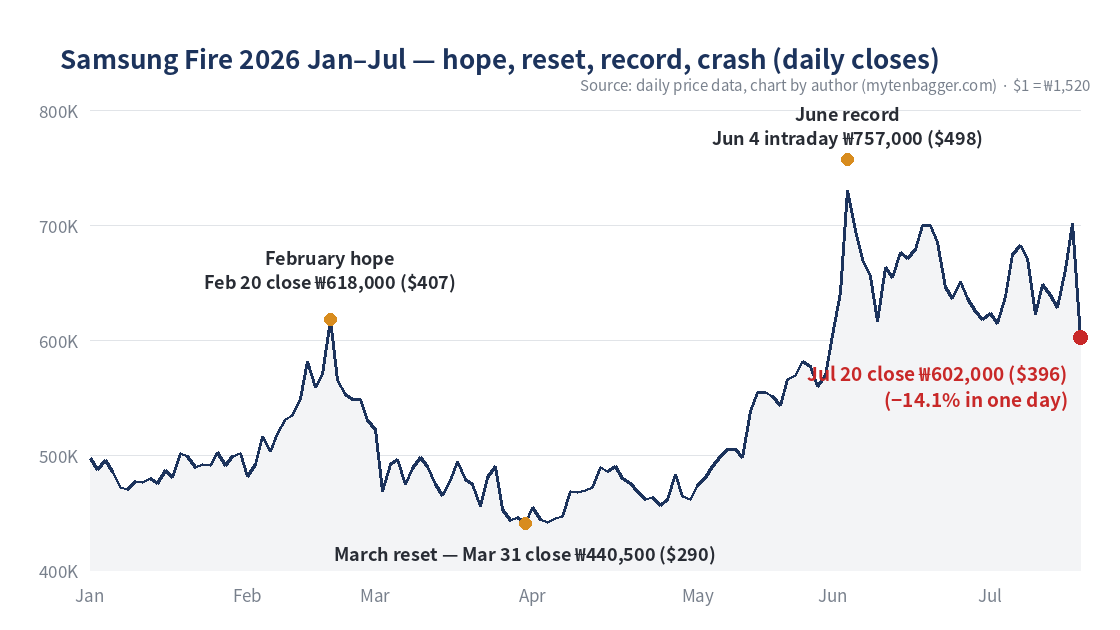
Samsung Fire stock lost more than 14% in a single session on July 20, and the first thing I opened was not the sell ticket — it was a spreadsheet. Korea’s benchmark KOSPI index gapped down 2.6% that morning and fell as much as 4.5% intraday before foreign and institutional buying trimmed the damage, according to Financial News, a Korean outlet (my rendering from Korean, as with all Korean-language sources cited here). Insurance was the hardest-hit sector, down 5.93% in morning trade, with Samsung Fire & Marine Insurance off 8.13% before lunch. By the close it was worse: ₩602,000, or about $396 at the ₩1,520 per dollar rate I use throughout (Trading Economics) — down 14.1% from the prior session’s ₩701,000 ($461). Even on a day when the whole market broke, that is an outsized fall for Korea’s largest non-life insurer. So I spent the evening splitting the drop into its components, and when the split was done, I bought a small first tranche.
The 30-second version — my skeleton before the flesh.
① Almost none of the 14.1% traced back to the company. It was a market crash, plus a sector-wide de-rating, plus profit-taking after an 11% three-day bounce.
② Fundamentals point the other way: Q1 net profit of ₩634.7 billion (~$418 million) beat consensus, and the K-ICS solvency ratio of 270.1% is the strongest in the Korean industry.
③ At $396 a share, the already-declared FY2025 dividend alone yields 3.2%; the forecast for 2026 implies 3.8% (my arithmetic). I started with roughly a third of my planned position and tied the rest to three checkpoints, the first in mid-August.
Contents
What Actually Happened to Samsung Fire Stock on July 20
First, the numbers without adjectives. Thursday July 16 close: ₩701,000 ($461). Monday July 20 close: ₩602,000 ($396), a one-day loss of 14.1% that finished within a whisker of the session low. The KOSPI — Korea’s main stock index, the rough equivalent of the S&P 500 for Seoul-listed shares — opened at 6,643, sank to 6,515, and then clawed back most of the intraday hole. The index recovered; Samsung Fire stock did not. That divergence is the puzzle this piece exists to solve.
Context changes the picture. On July 13, Korea had what local media called a Black Monday: the KOSPI collapsed 8.95% in one session as semiconductor leaders cracked on peak-cycle fears, surrendering the 7,000 line (Infostock Daily via Investing.com, Korean outlet). Samsung Fire fell just 2.9% that day — it behaved exactly like the defensive stock it is supposed to be. Then, from the July 14 close of ₩628,000 ($413) to July 16, it rebounded 11% in three sessions as money hid in insurers. When the market broke again on the 20th, the money that had crowded in over three days left in one. I read the 14.1% as an event in the order flow, not an event at the company.
There is even a precedent for this stock producing violent moves that mean nothing about the business. Back in December 2025, on Korea’s quadruple-witching expiry, Samsung Fire spiked 28% into the closing auction and gave essentially all of it back the next morning — Korean press attributed the whipsaw to arbitrage liquidation around the derivatives settlement, not to any news (Herald Business, Korean outlet). A stock whose register is dominated by large, patient holders — foreigners alone own 58.2% — can print wild candles whenever a crowd moves through a narrow door. December taught me to ask what the flow was doing before asking what the company did. July 20 got the same question, and the same answer.
Three Layers of Selling Pressure on Samsung Fire Stock
Layer one: the market. July 2026 Korea is a market where the semiconductor generals that led the KOSPI toward 8,000 are being repriced for a cycle peak, and the index is falling in air pockets — 8.95% on the 13th, another gap down on the 20th. A company with a market value of roughly $17.7 billion (₩26.9 trillion — 44.65 million shares times ₩602,000, my multiplication) cannot hide from that kind of tape.
Layer two: the sector. Korean insurance fell 5.93% that morning as a group, and the group has its own problem. In late June, Korea’s financial authorities finalized a guideline that forces insurers toward more conservative actuarial assumptions — loss ratios, expense assumptions, lapse rates — applying from June-quarter closings. A Korean press report (Herald Business) put the industry-wide cost of just the inflation-adjusted expense provision at about ₩2 trillion (~$1.3 billion) of additional best-estimate liabilities. Nobody yet knows each insurer’s share of that bill. Markets sell first and allocate later.
Layer three: the stock’s own crowd. The three-day, 11% defensive rally I described above unwound in a single session. Strip out all three layers and what remains — new company-specific bad news dated July 20 — is, as far as I could find, nothing. No filing, no profit warning, no regulatory action naming the company. A 14% drop with no company in it is precisely the kind of drop I want to examine with a calculator rather than adrenaline.
The 2026 Round Trip: How Samsung Fire Stock Got Here
The year so far reads like a four-act play, and knowing the acts matters because they reveal what this stock actually trades on. Act one, January: a quiet box between ₩470,000 and ₩500,000 ($309–$329). Act two, February: shares ran to an intraday ₩644,000 ($424) ahead of full-year results on hopes of a capital-efficiency announcement — and when the specifics did not materialize, the stock slid 29% to ₩440,000 ($289) by late March. An NH Investment & Securities analyst later named the wound directly: the February results “lacked a capital policy that met the market’s bar” (Edaily Market-in, Korean outlet, my rendering). March added an insult: Samsung Life and Samsung Fire together sold roughly ₩1.5 trillion (~$1 billion) of Samsung Electronics shares in a block trade to stay ahead of a financial-holdings ownership cap, and the two insurers drew a line — no special dividend planned (News1, Korean outlet).
Act three, spring: NH upgraded the shares on April 14 with the stock at ₩488,000 ($321), arguing the dividend yield near 4% capped the downside. Q1 results on May 14 beat consensus and reopened the box. Act four, early June: on June 4, Samsung Fire jumped 13.9% to ₩730,000 while Samsung Life fell 8.7% the same day, as Seoul Economic Daily reported (Sedaily, Korean outlet) — the market deciding, in one session, which of the two Samsung insurers actually keeps the fruits of the Samsung Electronics stake story. The shares printed a 52-week intraday high of ₩757,000 ($498) that day. July gave most of it back. Notice what never appears in these four acts: loss ratios, interest rates, typhoons. Every act turns on one question — what will this company do with its capital? With foreign investors holding 58.2% of the register, the shareholder base is dominated by exactly the money that asks that question loudest.
Earnings Point the Other Way
A 14% drop deserves a check of whether the business is actually deteriorating. The May 14 first-quarter report says no. Net profit attributable to shareholders came to ₩634.7 billion (~$418 million), up 4.4% year over year and ahead of the sell-side consensus in the low ₩610 billion range, per Herald Business (Korean outlet). Pretax profit reached ₩857.7 billion (+4.3%) and operating profit ₩914 billion (+11.9%). Underneath: insurance service income of ₩551 billion (~$363 million, +5.0%), investment income of ₩362 billion (+24.4%), long-term insurance income of ₩440 billion (+4.9%), a general-insurance line whose loss ratio improved 9.9 points to 53.6% and whose income more than doubled to ₩104.7 billion, and overseas earnings up 48.2% — driven by a ₩58.2 billion (~$38 million) equity-method contribution from Canopius, the Lloyd’s of London specialty insurer in which Samsung Fire holds a stake, up 127.6% from a year earlier. The K-ICS solvency ratio — Korea’s post-IFRS 17 capital measure, conceptually similar to Europe’s Solvency II ratio — stood at 270.1%, the highest tier of the industry. For scale at another non-life name, Hyundai Marine & Fire’s K-ICS ratio was 209.0% at the end of the second quarter of 2026 (Hyundai Marine stock). A first-quarter tranche of treasury-share cancellation was completed on schedule, and the stock of contractual service margin, the deferred-profit inventory of an IFRS 17 insurer, reached ₩14.4 trillion (~$9.5 billion) against the company’s mid-term goal of ₩15 trillion.
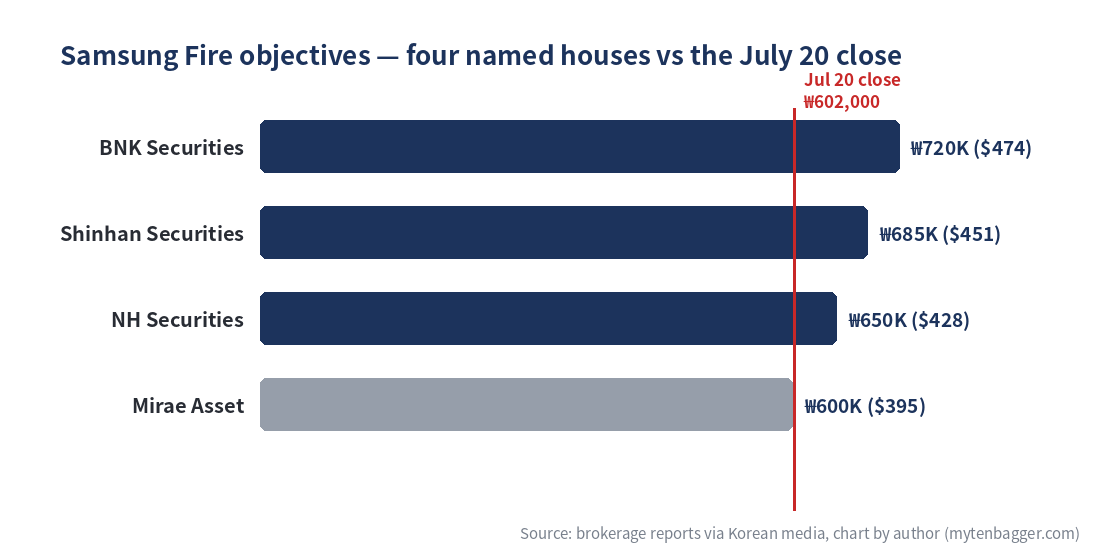
The forward view, with names attached. BNK Investment & Securities analyst Kim In raised his objective 35.8% to ₩720,000 ($474) on July 14, modeling 2026 net profit of ₩2.3 trillion (~$1.51 billion, +15.9%) and a second quarter of ₩715.1 billion (~$470 million, +12.2%) (Newspim, Korean outlet). On his numbers, the whole company at $17.7 billion trades at 11.7 times this year’s profit — again, my division. NH’s Jung Jun-seop carries ₩650,000; Shinhan Securities set ₩685,000 in May; the street average compiled by Newspim is ₩693,889, about 15% above the July 20 close. I hold analyst objectives loosely — they are a mood ring, not a map — but the direction of that mood since April has been one-way: up.
The Disclosed Payout Rules Beneath Samsung Fire Stock
What I weight more heavily than any quarter is a board-level disclosure. On January 31, 2025, Samsung Fire published a corporate value-up plan — Korea’s answer to Japan’s Tokyo Stock Exchange governance reforms — with three load-bearing numbers: lift the total shareholder return ratio to around 50% by 2028, shrink treasury shares from the mid-15% range at the time of the disclosure to below 5% through cancellation, and manage the K-ICS ratio around a 220% line, with a sustained ROE ambition of 11–13% (Korea Financial Times, Korean outlet). This is not a broker’s wish list; it is the company’s own filed roadmap.
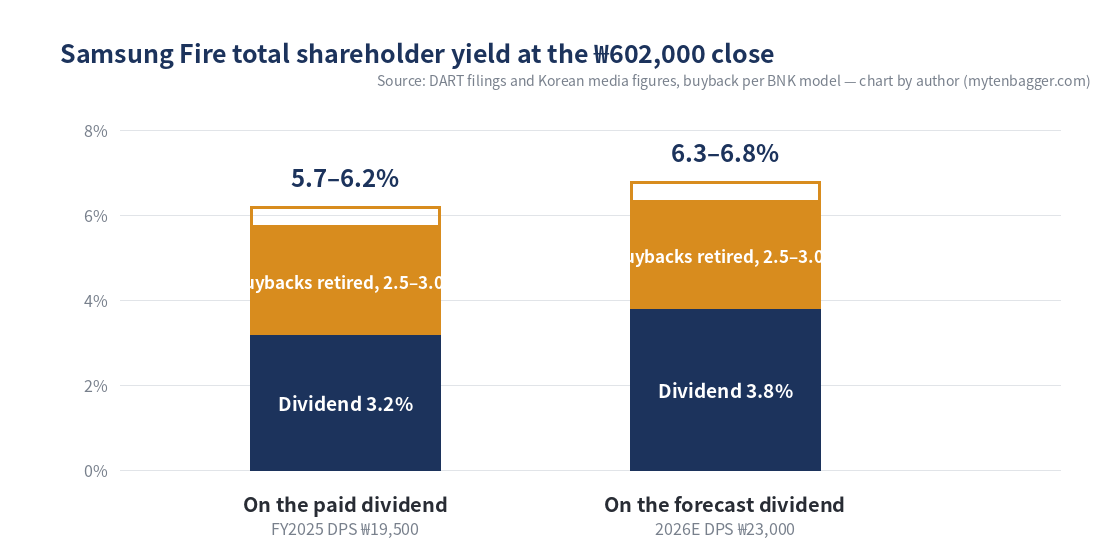
Now the arithmetic that made me a buyer. The FY2025 dividend, already declared per Korean regulatory filings, was ₩19,500 per share (~$12.83) — a 3.2% yield on the crash-day price with zero forecasting involved. Sedaily has reported a 2026 forecast of ₩23,000 (~$15.13), which would be 3.8% at $396 — my division, on a reported forecast. Stack the buyback: BNK’s model assumes 2.5–3.0 percentage points of share count retired per year. Dividends plus cancellation puts the total-return math at roughly 6.3–6.8% of the market cap annually on the forecast dividend, or 5.7–6.2% on the declared one — all reverse-engineered by me from the sources above, and all anchored to a disclosed 50% roadmap rather than to hope. That band is the single highest-conviction paragraph in this piece.
Two supporting details make the roadmap more than paper to me. First, the track record: per Korean regulatory filings, the per-share dividend has climbed four years running — ₩13,800 for 2022, ₩16,000 for 2023, ₩19,000 for 2024, ₩19,500 for 2025. Not one cut across that stretch, through a full accounting-regime change to IFRS 17. Companies reveal their payout culture in sequences, not speeches. Second, the capital cushion: the company manages solvency to a 220% K-ICS line by its own disclosure, and it is running at 270.1%. That fifty-point gap is, functionally, the pre-funded war chest behind the cancellation program — the payout promise is not competing with a capital shortfall for the same won. When I say the floor under this stock is built from filed numbers, these two are the rebar.
Where Samsung Fire Stock Sits Among Global Insurers
For a reader who benchmarks everything against U.S. names, here is the structural translation. Samsung Fire is Korea’s largest property and casualty insurer — think of the market position of a Progressive or an Allstate at home, layered with a Berkshire-flavored twist: a giant legacy equity stake (Samsung Electronics) and a Lloyd’s specialty arm (Canopius) sitting on top of the domestic underwriting engine. The economics I care about are the classic P&C trio — underwriting discipline, investment float, and capital return — and on the first two the Q1 numbers above speak for themselves. On the third, the gap with global peers is the story: large U.S. and Japanese insurers have long traded at healthy premiums to book value in part because their capital-return policies are credible, while Samsung Fire changes hands at about 1.3 times book with an 11% ROE (my figures from Korean market data) — a discount that exists precisely because Korean payout credibility is young. I deliberately cite no specific peer multiples here; I could not verify current figures for Progressive, Chubb, or Tokio Marine to my standard while writing, and I would rather show a gap in my research than a number I have not checked. The mechanism I am relying on is the one Japan already demonstrated: when the Tokyo exchange pushed governance reform, insurers that unwound cross-holdings and lifted payouts re-rated over several years. Korea’s value-up program is the same experiment a few years younger, and Samsung Fire’s January 2025 filing is one of its most concrete specimens.
The Samsung Electronics Stake: A Second Engine, Half-Loaded
For U.S. readers the cleanest analogy is Japan: Tokio Marine and its peers have spent years selling down legacy cross-shareholdings and handing the proceeds back to shareholders, and the market has paid them for it. Samsung Fire owns about 1.5% of Samsung Electronics (BNK’s tally) — a legacy strategic stake worth billions of dollars that Korean law now actively pushes toward the exit: as Samsung Electronics cancels its own shares, the combined stake of Samsung Life and Samsung Fire creeps toward a 10% regulatory ceiling, forcing periodic sales like March’s ₩1.5 trillion block. June 4 was the market pricing the difference between the two holders — Samsung Life must share large slices of such gains with participating policyholders, Samsung Fire keeps far more of them, hence +11% and −11% on the same headline.
I load this engine at half weight, deliberately. The companies themselves said in March that no special dividend is planned. BNK pencils in a special payout of about ₩1 trillion for 2027 — but that is an analyst’s estimate, not a company commitment, and I refuse to buy a stock for a promise nobody made. The stake sits in my ledger as optionality: worth something, priced at nothing in my thesis, with the filed 50% roadmap doing all the structural work.
The Bear Case Against Samsung Fire Stock
Now the strongest material against me, in order of weight. First, growth quality. Mirae Asset Securities — the most conservative named house at ₩600,000, almost exactly the current price — flagged in May that new-business CSM fell 11% year over year (report briefing via Nate, Korean outlet). CSM is the warehouse from which an IFRS 17 insurer’s future profits are released; less new inventory in the warehouse is a critique that a good quarter does not answer.
Second, the actuarial guideline has not yet presented its bill. The first financials to carry it are the June-quarter results due in August. The industry-wide ₩2 trillion estimate says nothing about how much lands on this company; I do not know, and I am writing that I do not know. Third, price regulation. Korean auto insurance lives under near-permanent government pressure toward premium cuts (Asia Today, Korean outlet), and management itself guided auto loss-ratio improvement only for the second half. Fourth, precedent. This exact stock lost 29% between February and late March because a capital announcement missed expectations. A thesis built on payout discipline gets punished hardest when the payout disappoints — this year already proved it once. And the meta-risk for a dollar-based reader: all of this is denominated in won, near multi-year lows against the dollar, so a Korean equity position is simultaneously a currency position.
My Plan: A First Tranche and Three Checkpoints
The ledger nets out like this. The crash-day drop had no company in it; earnings and capital are solid; the payout is bound by a filed roadmap; the declared dividend alone pays 3.2% while I wait. Against that: shrinking new-business CSM, an unpriced regulatory bill, auto-premium politics, February’s scar, and the won. I judged the low-₩600,000s ($396) a place to begin, not to finish — I took roughly a third of my intended position near the July 20 close and staged the rest behind three checkpoints.
Checkpoint one — mid-August: Q2 and the actuarial invoice
The June quarter is the first to absorb the new assumption guideline. I am watching two numbers: actual net profit against BNK’s ₩715.1 billion estimate, and whether K-ICS holds above 250%. A big profit miss combined with a sliding solvency ratio would mean the regulatory bill is larger than the street assumes — I would stop adding and rewrite the thesis from scratch. A modest miss with capital intact keeps the plan alive.
Checkpoint two — year-end: the direction of the FY2026 dividend
This is where the 50% roadmap either compounds or cracks. Anything at or above the declared ₩19,500 with an upward trajectory keeps the structure standing, even if it lands short of the reported ₩23,000 forecast. A dividend that retreats below ₩19,500 — whatever the stated reason — breaks the load-bearing column of this thesis, and I would exit rather than renegotiate with myself.
Checkpoint three — continuous: auto-premium politics
The line I watch is the moment pressure becomes mandate. If a formal rate cut arrives, I wait for one full quarter of results to see how much the long-term insurance book absorbs before adding anything. Note that medical-indemnity premiums are already set to rise 7.8% on average in 2026 per Korean press, so autos are the main pricing battlefield left. The Samsung Electronics stake and any special payout stay at weight zero — a bonus if they arrive, no damage to the thesis if they never do.
One more scenario belongs on paper before the next gap-down morning. If the KOSPI keeps falling, my test is relative behavior: on July 13 this stock defended with a 2.9% loss against the index’s 8.95% collapse, and that is the defensive pattern I am paying for. If instead it keeps printing days like July 20 — falling multiples of the index — then the market is no longer trading flows; it is repricing the insurance sector for the actuarial regime, and I slow the staging down regardless of how attractive the yield arithmetic looks. Same drawdown, different composition, different response — that distinction is the whole method of this piece.
A practical note for readers outside Korea: Samsung Fire & Marine trades on the Korea Exchange under ticker 000810. Crash days are loud. The only quiet work available to me was to decompose the fall, price the floor off filed numbers, and write the checkpoints down before the next loud day arrives. This is that record — read it beside my Samsung Life analysis to see why the same headline is worth different amounts to two different balance sheets.
Related reading
- Korean Brokerage Stocks: The 2026 Law That Re-Rated the Sector
- Before DB Insurance Stock, I Priced the 4.3 Points Left