Samsung Securities: Why It Held While Kiwoom Fell 30%
- I hold a small defensive position in Samsung Securities — the one name in this series I already owned before writing it. While Kiwoom fell more than 30% from its May high, Samsung Securities held a ₩110,000–₩120,000 (~$80–$87) range.
- The reason is that its profit has a different root. Samsung Securities earns more from ₩432T (~$313B) of retail client assets and affluent-client fees than from trading volume — recurring income that’s less hostage to the tape.
- On top of that sit two catalysts: a short-term-financing-bond license it now qualifies for, and a rising dividend (2026 estimate ₩5,500). My breakpoint is that wealth management still ultimately tracks asset values.
Writing this series, I’ve kept all five brokers up on my screen one at a time. One of them stayed quiet while the others thrashed. The day I was working through Kiwoom — which was routinely down 5% intraday — this one barely moved. It’s also the one name of the five I already owned, a small position I’d put on as ballast. This selloff turned out to be a live test of whether that ballast actually works. So this piece isn’t me picking apart someone else’s stock; it’s me re-checking why I hold my own. To be upfront: the position is small, not a core weight. The question here isn’t “should I buy” but “should I grow this defensive sliver into a core holding, or leave it,” and the drawdown just handed me the data to judge that. I’ve held it long enough to have a cost basis I’m comfortable with, which changes how I read a drop like this — I’m not deciding whether to start, I’m deciding whether to double down, and those are different questions with different tolerances for being wrong.
Contents
Why Samsung Securities held its ground — a different profit root
Start with the fact. Kiwoom fell more than 30% from its May high in two months. Over the same stretch, the stock — after a brief May spike — has traded in a ₩110,000–₩120,000 range. It’s up more than 60% over twelve months but roughly flat over three. Same sector, visibly different volatility. I don’t think that’s luck; I think it comes from the structure of the earnings.
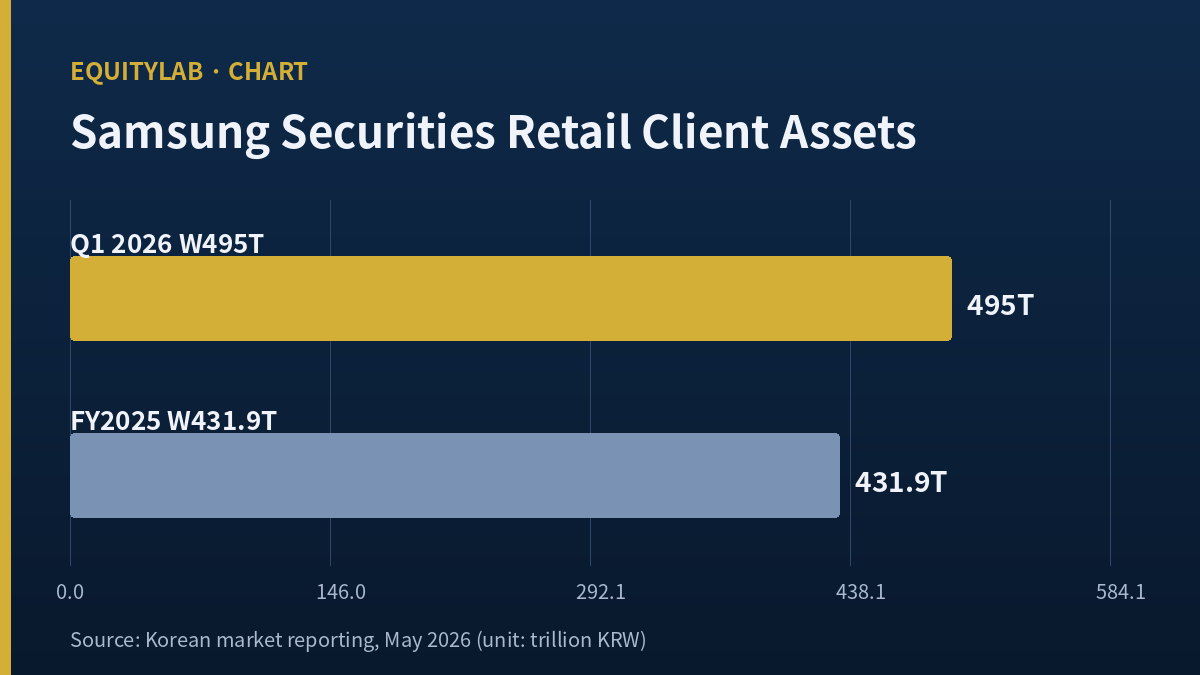
If Kiwoom’s profit is hostage to trading volume, Samsung Securities’ profit is more hostage to the assets its clients park with it. Its retail client assets reached ₩431.9T in 2025, up 42.8% year-over-year, per Korean market reporting (Herald Business, May 15, 2026), and grew toward ₩495T by Q1 2026. Fees attached to parked assets keep coming in whether or not the client trades — the money stays in the account even when trading freezes. So when the tape cools, Samsung Securities’ profit shrinks more slowly than Kiwoom’s, and the stock falls more slowly too. Holding up in the selloff is that structure showing itself. Korea’s Samsung Securities publishes its business mix in English on its IR site, so a US reader can verify the wealth-management tilt directly.
Three reasons I hold Samsung Securities as a defensive position
First: affluent wealth management — recurring income that changes the profit’s character
The company is a long-established wealth-management leader, and its book skews to the ultra-wealthy. Its “SNI” brand for clients with ₩3B+ (~$2.2M) in assets passed 6,000 clients in early 2026 and reached roughly 7,700 by April (per Korean reporting, Insight Korea, May 12, 2026). Its family-office service for households with ₩10B+ manages ₩43T (~$31B) across 150 families. Clients like these don’t pull their accounts because the market turned; if anything, they lean on management more when volatility rises.
It shows in the numbers. Q1 financial-product sales revenue jumped 157.5% year-over-year, and within it wrap-account fees surged 483.2% (Korean reporting, Insight Korea, May 12). When asset-based fees — wraps, funds, trusts — grow like that, the character of the profit shifts from “money you earn only if trades happen” to “money you earn as long as assets stay.” That is the real reason I read this name as defensive rather than cyclical.
There’s a behavioral edge underneath the numbers, too. In a falling market, mass-market retail investors tend to trade less and retreat — which is exactly what drains a volume-driven broker. Ultra-wealthy clients often do the opposite: they lean harder on advice, rebalance through managed products, and sometimes add as prices fall. So the very conditions that starve Kiwoom’s commission engine can keep a wealth manager’s wrap and advisory fees steady, or even growing. That inverse behavior is a large part of why the two stocks moved so differently over the same two months, and it’s why I trust the defense here more than a low beta on a chart would tell me.
A few more figures round it out. Combined personal- and corporate-pension balances passed ₩30T, another pool of tape-independent assets. And this isn’t a wealth-only shop: in 2025 Samsung Securities lead-managed 11 IPOs and did 14 M&A-financing deals worth ₩2.06T (~$1.5B). Wealth management lays a defensive floor, and investment banking earns on top of it — total custody-fee revenue rose 143.9% in Q1 as brokerage and asset management grew together. This is not a company standing on one leg.
Second: a short-term-financing-bond license — climbing the capital-as-license ladder
In series #1 on Korea Investment Holdings, I wrote the line “capital becomes the license.” A short-term-financing-bond license opens above ₩4T of equity; Samsung Securities, at roughly ₩7T (~$5B) of equity, already clears the bar. Its move into that business is being discussed alongside dividend growth as a dual catalyst (Korean reporting, Prime Economy, March 3, 2026). Money funded through those bonds and deployed into corporate finance adds a layer of interest income that, again, is less hostage to the tape. It’s a growth option bolted onto a defensive base — and there’s one more rung above it: the IMA opens at ₩8T of equity, and sell-side work sees Samsung’s separate equity reaching about ₩8.6T by 2027, which would put it on the top rung of the same ladder Korea Investment Holdings just climbed. Still a plan, not a printed number — so I hold it as a reason and a breakpoint, not a certainty.
Third: the dividend — a clear direction and pace of return
The firm raised its 2025 dividend to ₩4,000 per share (DART filings), a yield near 3.75%. Sell-side work sees the 2026 dividend rising more than 10% to ₩5,500, with a long-term 50% payout-ratio target (Prime Economy, March 3). As I laid out in the opener, Korea’s value-up reform and its 2026 treasury-share cancellation law both reward companies that raise payouts. A firm heading toward a 50% payout ratio stands in front of that tilt. I add that direction of return to the defensive case.

Samsung Securities — the core data
Below are Samsung Securities’ wealth-management figures and stock metrics. Asset and WM figures are 2025–Q1 2026 (Korean market reporting: Herald Business, Insight Korea); stock metrics are recent financial data and DART dividend records. I cross-checked every cell against its source. USD uses ₩1,380/$.
| Metric | Value | Note |
|---|---|---|
| Retail client assets | ₩431.9T (~$313B) | 2025 +42.8% YoY (₩495T by Q1 2026) |
| SNI (₩3B+) clients | ~7,700 | 6,000 early 2026 → ~7,700 by April |
| Q1 2026 wrap-account fees | ₩32.6B (~$24M) | +483.2% YoY |
| P/E / P/B | 9.5x / 1.18x | ROE 13.1% |
| Dividend per share | ₩4,000 | FY2025, yield ~3.75% (2026E ₩5,500) |
| Shareholders’ equity | ~₩7T (~$5B) | above the ₩4T bond-license threshold |
Sources: assets & WM = Herald Business 2026-05-15 / Insight Korea 2026-05-12 (Korean reporting); metrics & dividend = recent financial data & DART FY2025 | As of: July 2026 | USD at ₩1,380/$
On the stock metrics alone, Samsung Securities sits in the middle of the pack. At 9.5x P/E and 1.18x P/B it’s dearer than Korea Investment Holdings (6.8x) and cheaper than Mirae Asset, and its 13.1% ROE trails the ~18% at Kiwoom and Korea Investment Holdings. It’s neither the cheapest nor the highest-ROE name. Its worth isn’t in one line of the table — it’s in the stability of the earnings. That’s why I hold it not as “the cheapest Korean broker” but as “the least volatile one.”
A practical note for US readers: this stock has no US-listed ADR, and it’s separate from Samsung Electronics (whose SSNLF trades over-the-counter). One edge worth naming: the Samsung brand itself is a wealth-management asset here. Affluent Korean clients associate the name with trust, and that halo helps the firm win and keep the ultra-wealthy accounts that anchor its defensive earnings — a soft moat that doesn’t show up in any valuation multiple.
And there’s a fact the table can’t hold: this asset base isn’t built overnight. Samsung Securities has spent more than 20 years accumulating affluent wealth-management relationships, and that trust is itself the barrier to entry. Trading commissions migrate to whoever is cheaper; a client with ₩3B or ₩10B on deposit doesn’t switch shops over a few basis points. That stickiness is what keeps assets from fleeing in a selloff, and it’s the real root under the stock’s defensiveness. You can see the same logic running in reverse at Kiwoom, where the cheapest, most price-sensitive retail flows are the first to leave for a slicker app. The stickiness of an ultra-wealthy book and the fickleness of a mass-retail book are opposite ends of the same spectrum — and this name sits firmly on the sticky end.
What the market misses on Samsung Securities — the “cyclical” label
This is the part I most want to make. The market files all brokers under one label: cyclical stocks that rise and fall with KOSPI. Samsung Securities goes in that bucket too. I think the label is only half-right for this name, because — as shown above — a large share of its profit comes from parked assets and affluent-client fees. A brokerage house and a wealth manager are both “brokers,” but their earnings wobble in different ways.
Here’s the yardstick I use. The question to ask about a broker isn’t “is trading volume rising?” but “what is the profit hostage to?” Kiwoom’s profit is hostage to trades, so it dances with the tape. Samsung Securities’ profit is hostage to assets, so it moves more slowly than the tape. Miss that distinction and you can’t explain why, in a selloff, one broker halves while another holds a range. That’s the differentiated read I hold on this name.
I own Samsung Securities as the “rises less, falls less” broker. If you want torque, that’s Kiwoom; if you want to dampen the swings, it’s Samsung Securities. Not that one is better than the other — this slot in my portfolio is defense, and it’s filling that role.
For a global reference, US readers know this shape. Samsung Securities is closest to a Morgan Stanley among Korean brokers — a house that leaned into wealth management to earn steadier, higher-quality income than a pure trading shop, the same move Charles Schwab made toward asset-based fees. The defensiveness and the re-rating case both come from that lean. I’m not pinning a peer multiple on it, but the template — a broker that gets re-rated as its wealth engine grows — is one that has already paid off in the US. Japan ran a nearer version of the same script: its brokers re-rated only once the Tokyo Stock Exchange forced a capital-efficiency reset in 2023, and the ones that led were those with steadier fee income rather than pure trading.
That said, I write the limit of the defense too. Fees on parked assets are less hostage to “trading,” but they are hostage to “asset values.” If the market falls hard, the mark-to-market value of client assets drops, and asset-based fees drop with them. Samsung Securities isn’t decoupled from the tape — it’s just less sensitive to it. It’s a defensive stock, not an invincible one. Blur that line and I’d overvalue it too.
Two scenarios I’m watching on Samsung Securities
The path I see as more likely — the WM profit quality gets re-rated
My base case: as retail assets and the affluent base keep growing and asset-based fees take a larger share of profit, the market’s “cyclical discount” on Samsung Securities eases. Add the financing-bond business and another layer of tape-independent income stacks on. Sell-side research sees this side too — SK Securities projected 2026 net income of ₩1.378T (~$1.0B, +36.7%) and 16.1% ROE, with a ₩154,000 target (Prime Economy, March 3). I don’t adopt that target as my own, but I log that the sell-side is moving up on wealth management and dividends. If that re-rating runs, the mid-of-pack multiple I flagged earlier is exactly the room the stock has to close — a broker earning steadier income shouldn’t trade at a pure-cyclical discount forever. The inflection is the quarter when wrap and fund fees sustain their Q1 surge and the bond license becomes visible — that’s when the market starts re-reading this as a “wealth and corporate-finance platform” rather than a “cyclical broker.”
Where I could be wrong — defense loses to growth
I write the other side heavily. The value of defense turns into a weakness in a bull tape. When trading volume explodes, a high-beta name like Kiwoom rises far more, and Samsung Securities lags. If the market decides “torque beats defense right now,” money leaves this name for Kiwoom. And if stocks correct hard, the asset-value drop eats into WM fees, as noted. A defensive stock doesn’t avoid falling — it just falls less. Low growth and imperfect defense: that in-between-ness is this name’s weakness. I know it, which is why I hold this as a defensive sliver, not as the whole of a core.
There’s a subtler version of the same risk. If the value-up re-rating lifts the whole sector, the cheaper, higher-ROE names — Korea Investment Holdings, or Kiwoom on a good quarter — may re-rate faster, and a mid-multiple defensive name can lag the very theme it belongs to. Being defensive doesn’t guarantee being first in line for the re-rating; sometimes the safe name is the last one the market gets excited about. I hold this stock knowing it may be a laggard in exactly the scenario I’m most bullish on for the sector.
That weakness stings most in a bull market. When others double and this name rises half as much, a holder feels the relative-loss pang of “why did I hold the defensive one?” I felt exactly that watching Kiwoom rip higher — and then this selloff settled the question for me. I count that psychological cost as part of the price of defense. Defense isn’t free, and paying for it knowingly is different from paying for it by accident.
My breakpoints — the line to grow it or trim it
I already hold Samsung Securities, so the breakpoint here isn’t “buy or not” — it’s “grow the weight, leave it, or trim.” I watch three things.
First is the durability of asset-based fees. Whether wrap and fund fees sustain the Q1 surge, or whether that was a one-off tape effect, shows up in the Q2 print. If it keeps growing, defense turns into a growth story too, and I grow the weight. Second is the actual progress of the financing-bond license — clearing the equity bar and building a book are two different things. Third is dividend execution — whether the ₩5,500 for 2026 and the 50% long-term payout harden as planned. Conversely, if asset-based fees prove a one-quarter flash and a correction shrinks client assets, I’d read the defense as weaker than I thought and trim. The order matters: fee durability answers first and weighs most, the license is the slower structural proof, and the dividend confirms management’s intent. And there’s a portfolio-level breakpoint I keep separate from the company itself: if my overall book shifts toward wanting more torque and less ballast, I might trim this even with nothing wrong at the business. A defensive holding is sized against the rest of the portfolio, not judged in isolation — that’s what makes it defense rather than a conviction bet.
I didn’t buy Samsung Securities as an exciting stock. I bought it as an anchor that keeps the account from swinging as hard when things break. This selloff confirmed the anchor did its job, so for now I hold. Defensive stocks are boring — that’s why this piece has no dramatic reversal in it. But on the day the whole account flips from green to red, seeing this dull name a little less red is when the reason for holding it makes sense again. Next I’ll set down NH Investment & Securities, the IB-heavy name with the highest dividend yield in the group. How much would you pay for a defense that falls less when the market breaks?