Why AhnLab Shares Fell by Half After the Political Rally
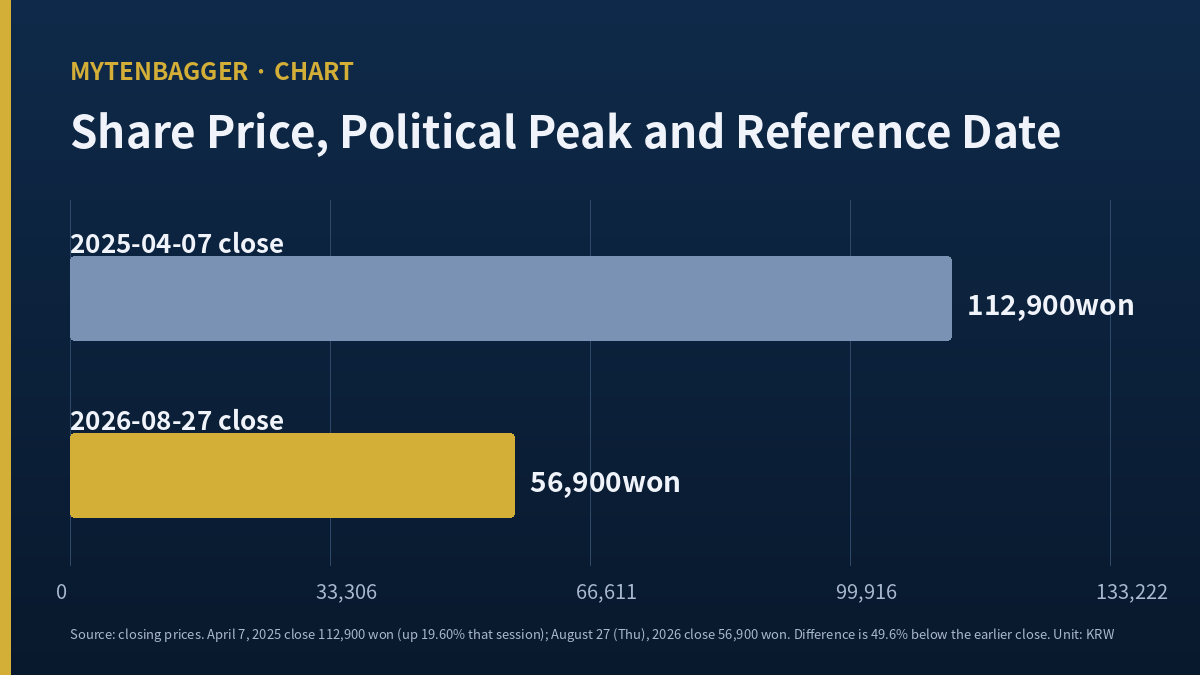
On April 7, 2025, AhnLab stock closed 19.60 percent higher at 112,900 won while the KOSDAQ index around it fell. Nothing about the company had changed that morning. What had changed was the political calendar: the founder of this cybersecurity firm, Ahn Cheol-soo, is a sitting Korean lawmaker and a former presidential candidate, and the market has priced his career into these shares for more than a decade. I want to start there because the number I am writing this piece around is measured from that day.
April 7, 2025 close: 112,900 won, up 19.60 percent on the session.
August 27 (Thu), 2026 close: 56,900 won.
Change between the two: down 49.60 percent, my calculation.
Founder purchases between June 26 (Fri) and July 31 (Fri), 2026: 78,000 shares, roughly 4.11 billion won.
Political sessions I could document in 2026: none.
That last line is the piece. For years the loudest moves in this name came from politics. In 2026 the only person visibly moving shares was the founder himself, buying on the open market for the first time since the company listed in 2001.
Contents
What AhnLab Stock Has Done Since That Day
My reference close is 56,900 won on August 27 (Thu), 2026, the last completed session before I wrote this on the morning of August 28 (Fri). Market capitalization works out to 633.1 billion won, or roughly 457 million US dollars, on 11,126,538 shares outstanding.
Where the price sits in its own range
Over the trailing 250 trading sessions the adjusted closing high is 75,000 won and the low is 50,800 won. My reference close is 75.87 percent of that high, down 24.13 percent from it, and 12.01 percent above that low. All three are my own calculations from the close above. Twelve-month change is negative 9.11 percent, six-month negative 12.73 percent, three-month negative 7.63 percent, one-month positive 7.36 percent.
One inconsistency belongs here. My data screen puts the 250-session low at 50,800 won, while Korean press reported a 52-week low of 52,000 won set on July 28 (Tue), 2026. The two windows are not identical and one may be an intraday print, but I did not settle which is correct. Every drawdown figure above uses 50,800 won.
The index this trades in
KOSDAQ is the smaller of Korea’s two main boards, the venture and mid-cap market that sits alongside the large-cap KOSPI. The divergence between them in 2026 matters for context here. KOSDAQ finished 2025 at 925.47 after a 36.36 percent annual gain, and closed at 826.87 on August 26 (Wed), 2026, which is a decline of 10.65 percent for the year to that date by my calculation. The KOSPI over the same stretch went the other way, closing above 6,910 on August 27 (Thu), 2026 against a 2025 finish of 4,214.17. A Korean small cap that is down for the year in 2026 is not an outlier. It is the median experience on that board, and Korean coverage in June 2026 put the share of KOSDAQ names down on the year at 63.8 percent.
The Founder Bought AhnLab Stock for the First Time in Twenty-Five Years
Between late June and the end of July 2026 the founder made three open-market purchases. Korean regulatory filings reported by the domestic press give the following.
| Dates | Shares | Approximate value | Stake after |
|---|---|---|---|
| June 26 (Fri) to July 2 (Thu) | 40,000 | 2.118 billion won | 17.08% |
| July 22 (Wed) to July 29 (Wed) settlement | 10,000 | 0.533 billion won | 17.17% |
| July 31 (Fri), at 51,963 won per share | 28,000 | 1.455 billion won | 17.42% |
Sources: Korean financial press reporting on the regulatory disclosures, including Financial News on August 7 (Fri), 2026 and Etoday on July 7 (Tue), 2026. Share counts add to 78,000 and the values add to roughly 4.106 billion won. The stake moved from 16.72 percent to 17.42 percent, a gain of 0.70 percentage points; dividing 78,000 shares by shares outstanding gives 0.7011 percentage points, so the two paths meet at the rounding.
The company’s public comment was that this was a personal investment decision. I am not reading it as a signal on its own. What I am recording is the change in what moves this name. In 2023 a single political session added 29.91 percent, and three sessions from January 25 to 27, 2023 carried the price from 70,200 won to 95,400 won, a gain of 35.90 percent, with Korean retail investors net buyers of about 18.8 billion won across those three days. In 2026 I searched for an equivalent political session and did not find one. The visible flow was a founder buying at prices near the low end of the year.
Nineteen percent of the shares are held by the company itself
Treasury holdings come to 2,138,159 shares, which is 19.22 percent of shares outstanding by my calculation, accumulated through buybacks reported in January 2025 and twice in December 2025 on the company’s own investor information page. I found no record of any of it being cancelled, which is not the same as confirming that none was. Add the 36.41 percent held between the founder, a Saudi-linked investment vehicle at exactly 10.00 percent, and a foundation, and 55.63 percent of the register is accounted for before any outside holder appears.
The Account That Decides Where AhnLab Stock’s Profit Lands
If you screen this company on net margin, you get 20.28 percent for the 2025 fiscal year on the vendor’s owners-basis figures, or 19.24 percent on the consolidated total from the Korean regulatory filing. Either number would place it comfortably inside the profitable half of any global security screen. The problem is that the margin is not made where the screen implies.
Four years, two very different ranges
| Fiscal year | Revenue | Operating profit | Net profit (total) | Net minus operating |
|---|---|---|---|---|
| 2022 | 227.98 billion won | 26.99 billion | 14.17 billion | negative 12.81 billion |
| 2023 | 239.20 billion won | 26.42 billion | 34.70 billion | positive 8.28 billion |
| 2024 | 260.57 billion won | 27.68 billion | 32.40 billion | positive 4.71 billion |
| 2025 | 267.66 billion won | 33.28 billion | 51.50 billion | positive 18.22 billion |
Consolidated, from the Korean regulatory filings as loaded into my data source. The fourth column is my subtraction. Figures are in Korean won throughout; the won is the reference currency for this piece.
Operating profit across these four years ranged from 26.42 billion won to 33.28 billion won, a band 6.85 billion won wide. Net profit ranged from 14.17 billion won to 51.50 billion won, a band 37.32 billion won wide. Dividing the second band by the first gives 5.45. The bottom line swings 5.45 times as widely as the operating line, at a company whose revenue grew at a compound 5.49 percent a year over that stretch.
The 2025 gap between the two margins is 6.81 percentage points. Hold that number; it comes back when I line this company up against its listed peers.
The company has twice declined to describe it
The account itself is named in Korean coverage. In the second quarter of 2025 financial income reached 12.9 billion won against 2.5 billion a year earlier, and about 78 percent of that came from valuation gains on non-current financial assets measured at fair value through profit or loss, which works out to roughly 10.1 billion won. When those gains did not repeat, second-quarter 2026 net profit fell 52 percent even though revenue rose 14.48 percent and operating profit rose 55.64 percent (Bloter, July 29 (Wed), 2026).
What is not disclosed is the composition. Asked in 2024 about a 14.0 billion won financial income year, the company said only that valuation gains had risen sharply on strength in US equities and did not identify the holdings (Digital Daily, March 22, 2024). Asked in late 2025 which financial assets had been sold, a company representative said that disclosing the detail would be difficult (Bloter, October 29, 2025). Both quotations are my summaries of Korean-language reporting, not English-language originals.
So I can size the account and I cannot see inside it. For a US reader that is the practical translation of this whole piece: the operating business is legible and the bottom line is not.
Cash, checked separately
Valuation gains are accounting entries, so I looked at cash on its own. First-half 2026 operating cash flow was 34.95 billion won and capital expenditure 4.06 billion won, leaving 30.89 billion won of free cash flow against 10.38 billion won of net profit for the same half, a ratio of 3.37 by my calculation. The half without the valuation gains still collected cash. I put that on the other side of my own argument.
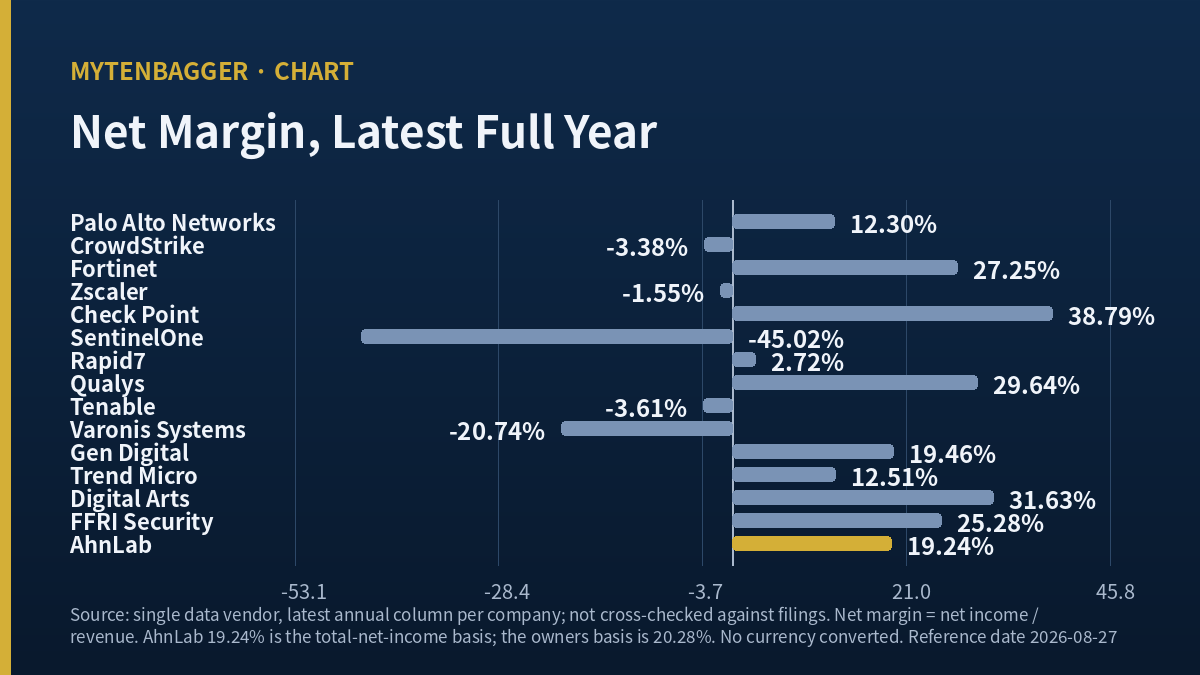
AhnLab Stock Against Fourteen Listed Security Companies
I built this table for one reason: to see whether a 6.81 percentage point contribution from a financial account is a rounding detail or a material share of what a security software company earns. The last column is the one I added deliberately. It says how many completed months separate each company’s latest annual figures from my reference date of August 27 (Thu), 2026, because the vendor’s most recent annual column is not equally recent for every row.
| Company | Listing | Fiscal year end | Revenue | Net income | Net margin | Months old |
|---|---|---|---|---|---|---|
| Palo Alto Networks | NASDAQ PANW | 2025-07-31 | 9,222m USD | 1,134m | 12.30% | 12 |
| CrowdStrike | NASDAQ CRWD | 2026-01-31 | 4,812m USD | negative 162.5m | negative 3.38% | 6 |
| Fortinet | NASDAQ FTNT | 2025-12-31 | 6,800m USD | 1,853m | 27.25% | 7 |
| Zscaler | NASDAQ ZS | 2025-07-31 | 2,673m USD | negative 41.5m | negative 1.55% | 12 |
| Check Point Software | NASDAQ CHKP | 2025-12-31 | 2,725m USD | 1,057m | 38.79% | 7 |
| SentinelOne | NYSE S | 2026-01-31 | 1,001m USD | negative 450.7m | negative 45.02% | 6 |
| Rapid7 | NASDAQ RPD | 2025-12-31 | 859.79m USD | 23.38m | 2.72% | 7 |
| Qualys | NASDAQ QLYS | 2025-12-31 | 669.13m USD | 198.32m | 29.64% | 7 |
| Tenable | NASDAQ TENB | 2025-12-31 | 999.41m USD | negative 36.12m | negative 3.61% | 7 |
| Varonis Systems | NASDAQ VRNS | 2025-12-31 | 623.53m USD | negative 129.32m | negative 20.74% | 7 |
| Gen Digital | NASDAQ GEN | 2026-04-03 | 5,000m USD | 973m | 19.46% | 4 |
| Trend Micro | TSE 4704 | 2025-12-31 | 275,984m JPY | 34,523m | 12.51% | 7 |
| Digital Arts | TSE 2326 | 2026-03-31 | 10,835m JPY | 3,427m | 31.63% | 4 |
| FFRI Security | TSE 3692 | 2026-03-31 | 4,348m JPY | 1,099m | 25.28% | 4 |
| AhnLab | KOSDAQ 053800 | 2025-12-31 | 267,657m KRW | 54,272m (owners) / 51,495m (total) | 20.28% / 19.24% | 7 |
Peer rows are 11 US-listed names and 3 Tokyo-listed names, which adds to 14 before my own row. Every peer row comes from a single data vendor and none of it is cross-checked against a second provider or against primary filings; I am stating that plainly instead of implying breadth I do not have. Net margin is my own division of the two columns beside it. Two companies I considered were left out on purpose: CyberArk, which the same vendor records as delisted on February 11 (Wed), 2026 following an acquisition, and WithSecure, whose latest annual column is still 2024 and would have entered this table 19 months old. No currency is converted anywhere in this table.
Now the number I asked you to hold. Six of these fourteen companies reported a full-year net margin below 6.81 percent, and five of those six posted an outright net loss. In other words, the margin contribution that came out of an undescribed financial account at this Korean company is larger, on its own, than everything six listed security businesses managed to keep from a year of revenue. That is not an argument that the company is better than any of them. It is an argument that the account is not a rounding detail.
What I Could Not Confirm About Who Holds AhnLab Stock
I am dating each check rather than each conclusion, because the honest state of this section is that some of it I verified and some of it I only sampled.
AhnLab does not appear in the top 25 of either that fund or the Franklin FTSE South Korea ETF, whose holdings list was dated August 14 (Fri), 2026. Beyond the top 25 both lists were paywalled, so I confirmed absence from the visible portion only.
What This Company Actually Sells, and Who Is Buying
The operating business is a Korean endpoint and network security vendor with a domestic antivirus franchise, managed detection and response services, and a newer zero-trust product line. First-half 2026 consolidated revenue was 130.37 billion won, up 9.12 percent, with consolidated operating profit of 7.31 billion won against 12.5 billion won on a parent-only basis. The 5.2 billion won difference is what the subsidiaries consumed, which is 41.60 percent of the parent’s operating profit by my calculation, using the company’s rounded parent figure. As of 2024 reporting, only the China unit among six subsidiaries was profitable.
Policy is the demand curve here
Korean security spending is unusually policy-driven, and two programs matter for this name. The government is replacing blanket network separation in the public sector with a tiered model that classifies work information as confidential, sensitive, or open; six consortia were selected for pilots with about 4.5 billion won of support and completion targeted for December 2026, and Korean public-sector security demand for 2026 was forecast at 973.3 billion won, up 22.5 percent, with operations and maintenance accounting for 69.1 percent of build spending (Daily Secu, April 1 (Wed), 2026). Separately, a state-funded cybersecurity AI foundation model has come down to two consortia, one of which includes this company, with the award expected during September 2026 (Digital Daily, August 26 (Wed), 2026). The company said its zero-trust and endpoint detection lines grew in triple digits in the first half on this demand, though it did not publish the base amounts those percentages are measured from.
Exports are growing from a small base
First-half 2026 exports were 10.4 billion won against 6.0 billion a year earlier, lifting the export share from 5 percent to 8 percent; dividing 10.4 by first-half revenue of 130.37 gives 7.98 percent, which reproduces the reported share. Korean coverage put the growth at 74.5 percent while dividing the two rounded figures gives 73.33 percent, a 1.17 point difference that comes from the rounding in the source. A Saudi joint venture in which the company holds 25 percent contributed 5.3 billion won of revenue and related transactions, against 2.2 billion a year earlier. For scale, the Korean government’s own industry survey published in November 2025 reported that national information security exports fell 15.9 percent in 2024, so this company grew its exports while the domestic industry’s did not.
Nobody is publishing estimates on it
There is no sell-side forecast in this piece because I could not find one. The most recent broker report I located was dated September 18, 2023, from a Shinhan Investment Corp analyst. A Korean corporate data service queried on August 27 (Thu), 2026 showed no analyst opinion issued in the prior three months and empty cells for 2026 and 2027 revenue and operating profit estimates, with zero contributing houses. For a company with a 633.1 billion won market value that is a coverage vacuum, and it means every multiple in this article is mine, unchecked by anyone else’s arithmetic.
Five Places This Reading of AhnLab Stock Breaks
- I never opened the filings. The Korean regulatory disclosure system was unreachable from this session. The itemized breakdown of financial income, the split between interest, dividends, valuation gains and disposal gains, equity-method results, and the absolute size of the financial asset book are all unverified. There is a difference between a company withholding something and my failing to open the document, and this piece leans on two press quotations to bridge it.
- Absence of political sessions is not proof of a lost premium. I found no 2026 political move in this name, but 2026 also produced no comparable political event for it to respond to. No stimulus and no response look identical from the outside.
- The peer table rests on one vendor. Fourteen rows, one source, no primary-filing check, and fiscal years that end in four different months. Palo Alto Networks and Zscaler are a full year behind the rest.
- Subsidiary detail is two years stale. The unit-level losses I cite are from 2024 reporting. For 2025 and 2026 I substituted the parent-versus-consolidated subtraction, which tells me the size of the drag and not where it sits.
- The share count is unsettled by 28 shares. My data screen shows 11,126,538 shares outstanding and the figure I found in research is 11,126,510. Market capitalization rounds to the same 633.1 billion won either way, but the treasury percentage carries that gap.
Prices and multiples reflect the August 27 (Thu), 2026 close as checked at the time of writing. The single dollar conversion above uses roughly 1,386.30 won per dollar, the Seoul close of August 26 (Wed), 2026, which is one session before my price date; I have flagged that mismatch rather than smoothing it. Korean won is the reference currency throughout, and every figure marked as my calculation is a division I performed on the values printed beside it.
Related reading: LG CNS and the index points it gave up while beating its sector / Samsung SDS and the cash pile behind the AI headlines / SFA Engineering and a backlog that is two-thirds robotics / SOOP and a profitable quarter that lost cash