Namyang Dairy Q2 Results: Sales Rose as Gross Profit Fell
Namyang Dairy stock closed at KRW 42,100 (about $31) on September 23, 2026, which values its roughly 5.67 million common shares at about KRW 238.9 billion, or about $176 million. The company sold KRW 258.0 billion of goods in the April to June quarter, 11.2 percent more than a year earlier, and earned KRW 47.0 billion of gross profit on those sales, 2.9 percent less. The extra revenue came with less gross profit attached, and most of the extra revenue came from outside Korea.
I do not own shares. Namyang sits far outside the 100 largest companies on the Korea Composite Stock Price Index (KOSPI, the main board in Seoul), and my rule for names that size is to watch and write, with no position. What I wanted from this entry was simple. When a dairy company that spent five years in the red starts to grow again, where is the growth coming from, and what does each new won of sales carry with it?
- Sales from January to June 2026: KRW 483.2 billion, up 7.9 percent on the same months of 2025.
- Overseas sales in those months: KRW 46.6 billion, about 2.3 times the prior year, now 9.6 percent of revenue.
- By my arithmetic, overseas supplied about 74 percent of the KRW 35.5 billion sales gain; sales at home grew 2.1 percent.
- Gross profit over the same six months fell 3.8 percent, from KRW 95.4 billion to KRW 91.7 billion.
- My stance: watching. I want one quarter in which sales and gross profit rise together before I call the growth profitable.
Contents
Where Namyang Dairy stock found its new sales
The six-month numbers came out on August 14, 2026. Revenue for January to June was KRW 483.2 billion, operating profit KRW 1.8 billion and net income KRW 7.8 billion, according to Korean business daily Etoday’s report of the filing. Operating profit rose 79.5 percent, which sounds strong until you notice the starting figure was about KRW 1.0 billion.
The split between home and abroad is what caught me. Korean deal-news outlet Dealsite reported overseas revenue of KRW 46.6 billion for the six months, about 2.3 times the level a year earlier, and put the overseas share of revenue at 9.6 percent against 4.5 percent a year earlier. The second quarter alone brought in KRW 30.1 billion from abroad, up 168.7 percent.
Going back from that growth rate, last year’s six-month overseas revenue was about KRW 20.3 billion. That checks out against the 4.5 percent share: KRW 20.3 billion is 4.53 percent of last year’s KRW 447.7 billion. So overseas revenue grew by about KRW 26.3 billion, while total revenue grew by KRW 35.5 billion. By my arithmetic, 74 percent of the new sales came from outside Korea, and sales at home grew by about KRW 9.2 billion, or 2.1 percent.
What a 2.1 percent home market means for a Korean dairy
A 2.1 percent rise at home is slower than what the headline growth suggests, and I think that is the honest read of Namyang’s domestic business today. The company’s own framing points the same way. Dealsite reported that dairy fell from 54.4 percent of sales to 48.9 percent, while the protein drink brand Take Fit grew 76.1 percent and coffee drinks grew 11.5 percent. Milk is shrinking as a share of what Namyang sells.
The second quarter repeats the six-month split on a smaller scale. Overseas revenue of KRW 30.1 billion, up 168.7 percent, implies about KRW 11.2 billion a year earlier, so exports added about KRW 18.9 billion of the KRW 25.95 billion quarterly sales gain, or roughly 73 percent, by my arithmetic. At home, Dealsite reported convenience-store sales up 10.1 percent and food-service and business sales up 11 percent, which tells me the domestic number is a mix of growing channels and a shrinking core.
One more detail from the same report changed how I read the operating line. Baekmidang, the company’s dessert-cafe subsidiary, earned about KRW 0.56 billion of operating profit in the six months on KRW 16.0 billion of revenue, against a small loss a year earlier. Set against the group’s KRW 1.8 billion, that one cafe chain supplied close to a third of it, about 31 percent by my arithmetic and before any adjustments between group companies that I could not see. The dairy business itself earned even less than the headline suggests.
Namyang Dairy stock and a quarter where sales and gross profit split
Here is the part that made me slow down. Stock Analysis’s quarterly income table for Namyang shows revenue of KRW 258.04 billion for the quarter to June 30, 2026, against KRW 232.09 billion a year earlier. Gross profit was KRW 47.05 billion against KRW 48.47 billion. Revenue rose by KRW 25.95 billion; gross profit fell by KRW 1.43 billion.
Put as a rate, gross profit was 20.89 percent of sales in the second quarter of 2025 and 18.23 percent in the second quarter of 2026. The first quarter shows the same direction: 21.75 percent in 2025 and 19.85 percent in 2026, on the same table. For the six months together the rate went from 21.30 percent to 18.99 percent.
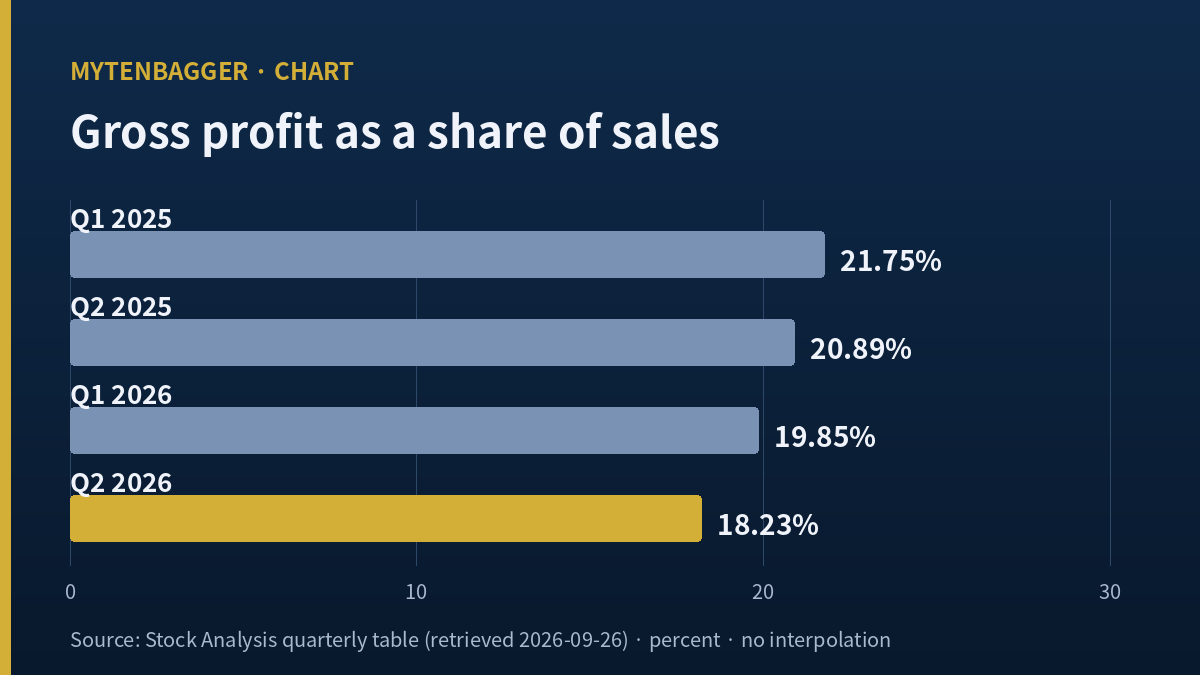
I first read the second quarter as a clean recovery. Operating profit rose from KRW 0.93 billion to KRW 1.28 billion, and the company’s release talked about exports and protein drinks. Then I lined up the four quarterly rates next to each other and changed my mind. A rising operating line on a falling gross profit line only works if selling and administrative costs drop faster than gross profit does.
Where the operating profit actually came from
That is what happened. Taking gross profit minus operating profit as the cost of selling and running the business, that figure was about KRW 94.4 billion for January to June 2025 and KRW 89.9 billion for the same months of 2026, by my arithmetic. It fell by KRW 4.4 billion. Gross profit fell by KRW 3.6 billion. The gap between those two cuts is the KRW 0.8 billion by which operating profit grew.
Cost discipline is a real achievement for a company that lost money for five straight years through 2024. I just do not want to confuse it with profitable growth. A business can cut its way to a thin profit once or twice. It cannot keep doing that while each new sale arrives with less gross profit than the last.
I covered the wider backdrop when I looked at Maeil Dairies in Korea’s first zero-tariff dairy year, where imported shelf-stable milk and falling per-person white milk consumption were the story. Namyang answers the same pressure from the other direction, by selling abroad. That earlier entry was about imports coming in; this one is about exports going out.
Namyang Dairy stock in six numbers
These are the figures I kept on my screen while writing. All won amounts are in billions; dollar figures use about KRW 1,358 per dollar.
| Item (Jan to Jun) | 2025 | 2026 | 2026 in USD |
|---|---|---|---|
| Revenue | 447.70 | 483.21 | $355.7M |
| Overseas revenue | 20.26 (by my arithmetic) | 46.6 | $34.3M |
| Revenue at home | 427.44 | 436.61 | $321.4M |
| Gross profit | 95.37 | 91.75 | $67.5M |
| Selling and running costs | 94.37 | 89.95 | $66.2M |
| Operating profit | 1.00 | 1.80 | $1.3M |
Revenue, gross profit and operating profit: sum of two quarters on the Stock Analysis quarterly table. Overseas 2026: Dealsite. Overseas 2025, revenue at home and selling and running costs are my own subtraction or division.
Two things stand out in the table. Revenue at home barely moved, and operating profit is still under 0.4 percent of revenue for January to June 2026, by my arithmetic. At that level, a one-point swing in the gross profit rate is worth about KRW 4.8 billion over six months, about 2.7 times the whole operating profit.
Namyang Dairy stock across five years of sales and losses
The quarter makes more sense against the longer record. Namyang Dairy Products was founded in 1964 and sells infant formula, milk, yogurt and coffee drinks, mostly in Korea. Private equity firm Hahn & Company became the controlling shareholder in January 2024, ending decades of founding-family control. The annual figures on Korean financial daily Hankyung’s financial overview page tell the story of the years around that change.
Revenue was KRW 956.1 billion in 2021, KRW 964.7 billion in 2022, KRW 996.8 billion in 2023, KRW 952.8 billion in 2024 and KRW 914.1 billion in 2025. Operating results over the same five years were losses of KRW 77.9 billion, KRW 86.8 billion, KRW 71.5 billion and KRW 9.8 billion, then a profit of KRW 5.2 billion in 2025. Between 2022 and 2025, revenue fell 5.2 percent while the operating result swung by about KRW 92 billion.
That is the part I think many readers miss. The return to profit in 2025 did not come from selling more. It came from selling somewhat less, at better terms and with lower costs. The 2026 pattern is the opposite: sales are growing again, and gross profit is not keeping pace. The company has switched from one problem to another, and the new problem is the better one to have. It is still a problem.
Eight quarters of the gross profit rate
To see when the rate started to slip, I lined up eight quarters from the same Stock Analysis table. Gross profit as a share of sales was 21.66 percent in the third quarter of 2024, 26.26 percent in the fourth, then 21.75, 20.89, 19.85 and 21.91 percent through 2025, and 19.85 and 18.23 percent in the first two quarters of 2026. The high point at the end of 2024 looks like a one-off to me; it came in a quarter with unusually high gross profit of KRW 60.8 billion on revenue of KRW 231.5 billion.
Leaving that quarter out, the rate has drifted down by about 3.4 points over two years, with one bounce in late 2025. The second quarter of 2026 is the lowest of the eight. I cannot tell from these figures alone whether that is the start of a new trend or the bottom of the old one, which is why I want the third quarter before I decide anything.
For comparison, I once wrote about how Binggrae’s summer quarters carry nearly all of its yearly profit. Seasonality is a known pattern in Korean dairy and ice cream. The Namyang drop shows up in both the first and the second quarter of 2026 against the same quarters of 2025, so season alone does not explain it.
A US dairy with the same split in the same quarter
I went looking for a listed dairy maker whose quarterly gross profit I could pull from the same data vendor, so the two numbers would be built the same way. Lifeway Foods (NASDAQ: LWAY), the Illinois kefir producer, fit that test. I am using it for one comparison only: gross profit as a share of sales in the June quarter, 2025 against 2026. I am not comparing size, valuation or anything else between the two companies.
On Stock Analysis’s quarterly table for Lifeway, revenue for the quarter to June 30, 2026 was $66.89 million against $53.90 million a year earlier, up 24.1 percent. Gross profit was $14.03 million against $16.23 million, down 13.6 percent. As a share of sales that is 20.98 percent against 30.11 percent.
So a Korean milk company and an American kefir company both grew sales in the June quarter and both took home less gross profit. I do not know that the causes are the same; Lifeway’s filing would have to tell me that, and I did not read it. What the pair does tell me is that sales growth at a lower gross profit rate is a pattern worth watching in dairy right now, and not a Namyang quirk I can wave away.
Why Namyang Dairy stock growth abroad may carry a lower rate
I can think of three reasons why the new overseas sales might carry less gross profit than the old domestic ones, and I cannot confirm any of them from what I read. Export deals often come with distributor rebates. Shipping and packaging for long distances cost more. And a company pushing into new markets may price low to get shelf space.
The honest position is that Namyang has not published a gross profit figure by region, as far as I could find. So the claim that exports carry a lower rate is my inference from timing: the overseas share doubled in the same months the overall rate fell. That is suggestive, and I hold it loosely.
A sales line I trusted too early
My own mistake here is worth writing down. For years I treated rising sales at a consumer company as the first good sign, the thing to confirm before looking at anything else. With Namyang I nearly did it again: the 11.2 percent quarterly jump read like a company coming back to life. It took the gross profit line, sitting right under revenue on the same table, to show me the growth was being bought. I now look at those two lines together before I let myself feel anything about either.
What owners of Namyang Dairy stock received this year
The cost side of the story matters for what shareholders can expect back. Namyang paid a 2025 year-end dividend of KRW 1,428 per common share and KRW 1,433 per preferred share, about KRW 11.2 billion in total, according to Korean outlet Asia A. About KRW 8.27 billion of that was a one-off special payout funded by money the former owning family deposited as restitution in an embezzlement case. The company also retired about 435,000 common and preferred shares worth roughly KRW 22 billion after a July 14, 2026 board decision, as Edaily reported.
Payouts of that size sit on top of an operating profit of KRW 1.8 billion for six months. They are not being paid from gross profit growth; there has not been any. For the payouts to keep coming from the business itself, the gross profit rate has to stop falling first.
I do not think the payouts are reckless. The company carries little debt, and a restitution deposit returned to shareholders is arguably the cleanest possible use of that money. My point is narrower. The yield a buyer sees on the 2025 dividend is mostly a one-off, and the regular part of it is small next to the share price. Anyone reading the dividend as a sign of a healthy dairy business is reading the special payout, and that payout will not repeat.
Where my read could be wrong
- Exports are young. New markets often start at low prices and improve once distribution is set, so the rate on overseas sales could rise from here. Two quarters is a short record to judge a change this new.
- The fall in the gross profit rate could come from raw milk prices, packaging or the product mix at home, with exports playing no part. I have no regional breakdown to rule that out.
- Cost cuts may be lasting. If the lower selling and running costs are structural, a thin but steady operating profit can hold even with a flat gross profit rate.
- I found no named brokerage covering Namyang in this round of research. There is no forward estimate to check my reading against, and every judgment here rests on filed figures only.
Two paths for the rest of 2026
The path I think more likely, at about 60 percent in my own estimate, is that the gross profit rate stays near 18 to 19 percent through the third quarter while overseas sales keep growing. Operating profit then stays thin, dependent on how far costs can still fall. The stock would have no new reason to move on earnings, and my watch stance holds.
I put a number on this path because it describes the most boring outcome, and boring outcomes are the ones I tend to underrate. In this path nothing breaks. Exports keep climbing, the domestic business holds roughly steady, and the company keeps finding small savings in selling and administration. The trouble is that each of those savings is used up once. If costs have already come down by KRW 4.4 billion in six months, the next KRW 4.4 billion will be harder to find, and the thin operating profit will start to track the gross profit rate more closely.
The other path, which I put at about 40 percent, is that the third quarter shows sales and gross profit rising together, with the rate back above 20 percent. That would tell me export pricing or the product mix has improved, and it would be the first sign that the growth pays for itself. I would then reopen this file and look at the numbers again with fresh eyes.
There is a third outcome I did not give a probability to, because I cannot size it: a large one-off item, such as a property sale or a legal settlement, that moves net income without telling me anything about milk. Namyang has had several such items in its recent past. If one shows up in the third quarter, I will set it aside and read the gross profit line on its own, the same way I did here.
Signals that would change my view
- Gross profit for July to September 2026 higher than the KRW 47.1 billion Namyang earned in the same quarter of 2025, on the Stock Analysis table.
- A gross profit rate above 20 percent in that quarter.
- Any regional breakdown of gross profit in a company release or filing.
- Overseas revenue in the third quarter below KRW 30.1 billion, which would mean the export engine is slowing before it pays off.
- Selling and running costs rising again while the gross profit rate stays near 18 percent.
- A named Korean brokerage opening coverage with its own estimates.
- Lifeway’s next quarter: if its gross profit rate recovers while Namyang’s does not, the industry explanation weakens and the company-specific one gets stronger.
The first two come first. The statutory date for the third-quarter report is November 16, 2026, and both will be visible that day.
The others I will weigh by how much they explain. A regional breakdown would settle the export question directly, so if one appears I will trust it over my timing argument. Lifeway’s next quarter is the weakest signal on the list, since one US kefir maker can only hint at an industry pattern. I keep it because it costs nothing to check and because it guards against my tendency to explain every Namyang number with a Namyang-only story.
Closing the Namyang Dairy stock entry for now
I am watching, with no position. The company is selling more, mostly abroad, and it is keeping less gross profit on each sale while cutting costs to stay in the black. That combination can last a while, but it cannot compound. I want to see one quarter where the top two lines of the income table move up together.
If that quarter comes in November, I will say so here and explain what I got wrong. If it does not, I will note that the export story grew sales and did not grow profit, and I will leave this name on the watch list for another year.
Prices and market value reflect the September 23, 2026 close on the Korea Exchange; the market was shut September 24 and 25 for the Chuseok holiday. Market value uses common shares only. Dollar figures are approximate, at roughly KRW 1,358 per dollar on the same date. Figures marked as my arithmetic are divisions or subtractions I made from the cited sources.
Related reading