Pan Ocean Stock Buys Tankers Into a 2028 Delivery Wave
Pan Ocean stock closed at 5,790 won on Friday, August 28, 2026, on the KOSPI, the main board of the Korea Exchange in Seoul and the index most foreign investors mean when they say Korean equities. That puts the company at roughly 3,095.2 billion won of market value, about 2.26 billion US dollars. What I keep returning to is not the price. It is a timing problem inside the company’s own capital spending.
Six lines I wrote down against the August 28 close
1. Pan Ocean secured seventeen very large crude carriers in the first half of 2026, worth roughly 2,318.1 billion won.
2. Ten were second-hand and already trading. Seven are newbuildings that arrive in 2029 and 2030.
3. The industry orderbook for the same vessel class reached about 35% of the existing fleet in the first half of 2026, against 2% in 2023, on MSI’s count.
4. Roughly 83% of those orders are due for delivery in 2028 and 2029. Shipbroker BRS counts 127 VLCCs due in 2028 alone.
5. So the new supply that could compress rates shows up before this company’s own ships do.
6. I hold none of it and have no order in. I am writing down what would change that.
Contents
Where Pan Ocean stock stands after the August 28 close
Pan Ocean is South Korea’s largest dry bulk operator, and it also runs tankers, liquefied natural gas carriers and a small container line. Harim Holdings and eleven related parties held 54.9% as of December 31, 2025, which is worth knowing because that concentration has driven the company’s biggest strategic swings. Foreign ownership sits at 17.46%.
The June quarter was strong on every line the wires carried. Consolidated revenue came in at 1,913.7 billion won and operating profit at 193.7 billion won, up 47.93% and 57.43% year on year respectively, which beat the FnGuide consensus of 155.9 billion won by 24.24% (Digital Daily, July 31, 2026, reporting Korean consensus data). By segment, dry bulk earned 84.7 billion won, tankers 43.7 billion won, LNG 49.7 billion won, and containers 14.5 billion won, the only line that shrank. Those four sum to 192.6 billion won; the 1.1 billion difference against the reported total sits in other and consolidation items.
The tape around that quarter was violent. Pan Ocean stock rose 10.84% on Friday, July 31, the day the numbers landed, then gave back 9.78% on Monday, August 3, closing at 4,935 won as the KOSPI itself fell hard that session. It then ran up to 6,380 on August 25, a closing high for the past 260 trading sessions, and fell 12.07% in the single session of August 26, a move I could not tie to any disclosure. It closed that week at 5,790. Anyone sizing a position off the earnings reaction alone would have been whipsawed inside two sessions, which is its own argument for reading the capital spending instead of the print.
One piece of local context matters for reading Korean shipping at all. HMM, the country’s container carrier and the sector’s largest listed name, remains roughly 70.5% state-held between the Korea Development Bank and the Korea Ocean Business Corporation (Insight Korea, August 19, 2026, in Korean), and its eventual sale has hung over the sector for years. That single unresolved transaction shapes how Korean shipping equities trade, including this one, for reasons I come back to below.
Freight is genuinely strong. The Baltic Dry Index closed at 3,186 on August 28, up 57.33% year on year (TradingEconomics). Underneath it, on August 27, the Capesize sub-index stood at 5,138 and Panamax at 2,292, with Capesize daily earnings around 46,601 US dollars (HandyBulk). None of that is in dispute. My question is about what the company did with the money.
For scale on how fast the freight backdrop moved, Shinhan Investment analyst Choi Min-ki put the second-quarter average Baltic Dry Index at 2,751 points, up 87.4% from the same quarter of 2025 (Newspim, July 15, 2026). An index that nearly doubles year on year will lift almost any operator with ships on the water, and it did. The company’s own first-quarter filing had already reported 1,508.9 billion won of revenue and 140.9 billion won of operating profit, so the half year builds to 3,422.6 billion won and 334.6 billion won respectively.
The sell-side response was to lift forward numbers instead of arguing with them. NH Investment analyst Jung Yeon-seung raised his 2026 and 2027 operating profit estimates by 19% and 23% after the June-quarter review, without publishing revised absolute figures in the coverage I could read. I am deliberately not carrying anyone’s valuation number into this piece, because the interesting disagreement in this name sits one level down, in what each house assumes those ten second-hand tankers will actually earn.
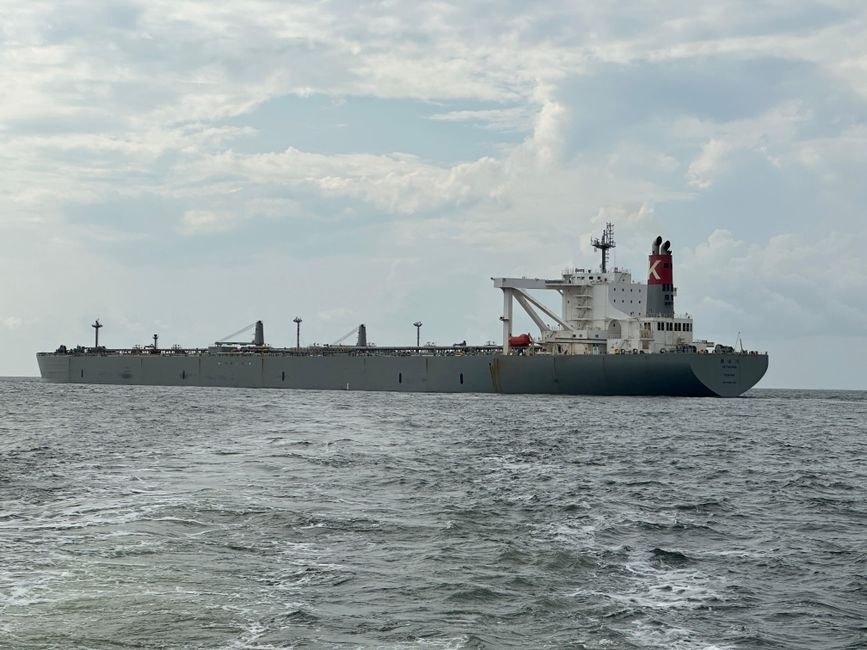
Seventeen tankers and their arrival dates
Between February and June 2026 the company committed roughly 2,318.1 billion won to seventeen VLCCs. Ten came second-hand, bought as a package from SK Shipping together with the long-term contracts already attached to them, for 973.7 billion won. The other seven were ordered from shipyards for roughly 1,344.4 billion won.
The dates matter more than the totals. The two units disclosed on June 29 carry a stated delivery date of September 27, 2030 (Digital Today, June 29, 2026, translating the Korean filing). The four ordered from Hanwha Ocean in May run through November 2030 (Hankyung, May 14, 2026). The twenty-year crude transport contract with SK Energy and SK Incheon Petrochem, worth 2,471.1 billion won, does not start earning until the ships begin service in mid-September 2029 (Shipping Newsnet, June 28, 2026).
So the second-hand ten are working now. The newbuilt seven are a 2029 and 2030 story. I want to hold that thought against what the rest of the industry ordered in the same six months.
The supply that would answer this trade lands first
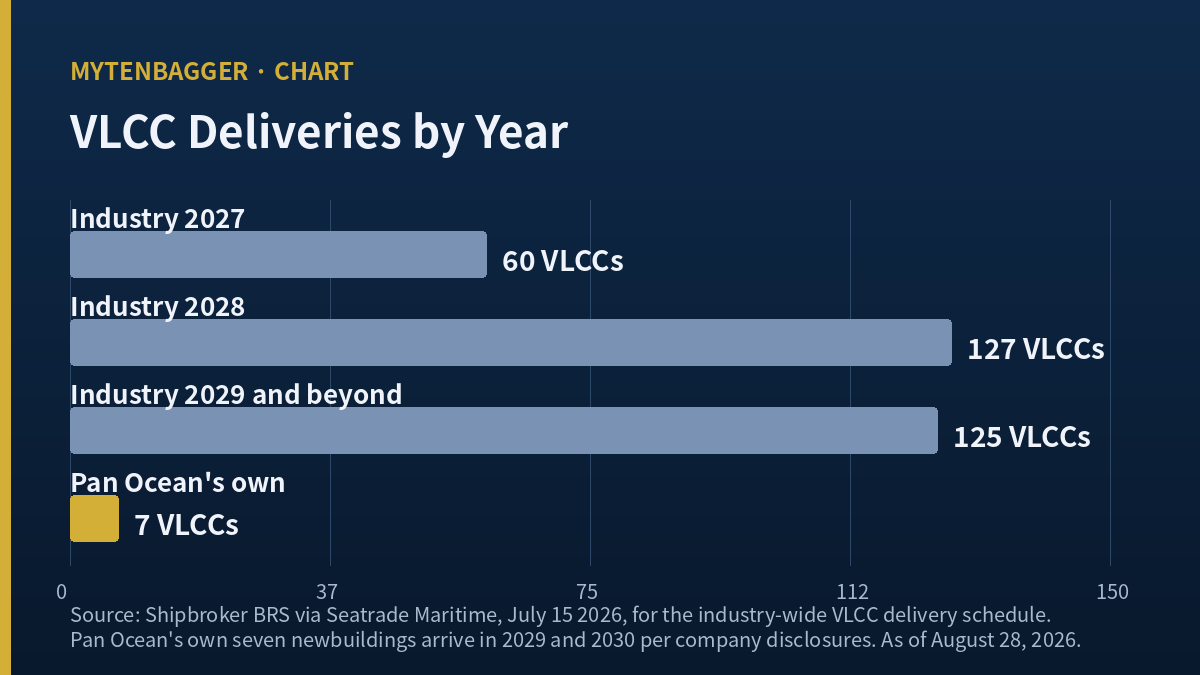
Everyone ordered supertankers in 2026. According to MSI, the VLCC orderbook-to-fleet ratio reached approximately 35% in the first half of 2026, compared with just 2% in 2023. MSI analyst Jialin Xu put it plainly: around 83% of the vessels ordered in that half are slated for delivery in 2028 and 2029. Shipbroker BRS counts 60 VLCCs due in 2027, 127 in 2028, and 125 in 2029 and beyond (Seatrade Maritime, July 15, 2026). Greek owners account for 72 of the ships on order and Chinese owners for 47.
Put those two sets of dates side by side. The wave of new capacity that could reset crude tanker economics arrives in 2028 and 2029. Pan Ocean’s own seven newbuildings arrive in 2029 and 2030. The company is not early to this cycle. Its ships enter a market that 127 other supertankers will have reached first.
That is the sentence I keep coming back to on Pan Ocean stock. The argument for owning it rests on tanker capacity the company will control in 2030. The strongest argument against it rests on tanker capacity everyone else will control in 2028. Both dates are already on paper. Neither is a forecast.
Whether that tonnage actually bites depends on how fast old ships leave, and the regulatory clock there has slipped. The European Union’s emissions trading system began covering shipping in 2024 on a phase-in, moving from 40% of 2024 emissions to 70% of 2025 emissions and reaching 100% from 2027. FuelEU Maritime started in January 2025 with a 2% greenhouse gas intensity cut that tightens in steps. But the International Maritime Organization’s net-zero framework, given initial approval in April 2025, had still not been formally adopted as of that November 2025 review, and Hana Securities analyst Ahn Do-hyun flagged the consequence directly: with adoption delayed, the retirement of older vessels that regulation was supposed to force may simply not happen on time (Shipping Newsnet, November 5, 2025). Delay is good for near-term costs and bad for the supply balance, which is an uncomfortable combination to own.
The same tension runs through the dry bulk fleet, which is still where most of this company’s profit comes from. Ahn’s numbers had 2026 bulk fleet supply growing about 3% against tonne-mile demand growing about 2%, with supply growth approaching zero only from 2027. A separate count reported from Affinity Shipping in July 2026 put roughly 15.4% of the world bulk fleet above twenty years old, an orderbook of 1,358 vessels equal to about 11% of the fleet, newbuild ordering down 41% from the prior year, and just two Capesize vessels scrapped year to date (Ocean Press, July 28, 2026). Few orders, but even fewer demolitions. A rate correction or a jump in scrap prices would release that overhang all at once.
Asset prices tell the same story from the other side. Reporting on VesselsValue data in April 2026 put Capesize newbuild prices at 76.87 million US dollars after a 1.27% rise, with Supramax secondhand values up 14.85% between January and April, from 29.76 to 34.18 million dollars (Shipping Voice, April 30, 2026). Buying vessels into that kind of asset inflation is not automatically wrong. It does mean the entry price for this fleet expansion was set near the top of a value cycle, not the bottom of one.
I will not overstate the precision here. Delivery dates slip, and a meaningful share of any orderbook historically arrives late or never arrives. The Chinese fleet also carries 77 VLCCs aged over twenty years, per the same BRS data, and heavy scrapping would absorb part of the new tonnage. But the direction of these delivery years reads clearly enough, and it works against an owner arriving in year three.
Pan Ocean stock and a balance sheet that moved ahead of the ships
Almost none of those seventeen vessels is generating revenue for this company yet, but the funding shows up now. Between December 31, 2025 and June 30, 2026, consolidated total assets grew 18.28% to 12,838.1 billion won while total liabilities grew 27.02% to 6,516.5 billion won. Equity grew 10.45%. The debt-to-equity ratio, as Korean filings compute it, went from 89.63% to 103.08%, the first reading above 100% in the four years I pulled from the regulatory database.
Shipping is a financed business and a leverage step-up around a fleet expansion is normal. Two numbers keep me watching instead of buying. First-half interest expense reached 155.0 billion won, up 19.94% year on year. And while first-half operating profit rose 41.59%, net profit rose 19.07%, to 232.0 billion won. Rising interest accounts for part of that gap. I could not account for what is left without the note disclosures, and I am recording that as unfinished, because it is.
The cash side is healthier than the leverage line suggests, and I want to give it its due. First-half operating cash flow was 420.8 billion won against capital expenditure of 136.3 billion won, leaving free cash flow of 284.5 billion won, roughly 9.2% of market value at the August 28 close. Interest cover, taking first-half operating profit over first-half interest expense, works out at 2.16 times. Neither number is distressed. What has changed since 2023, when the debt ratio sat at 66.63%, is the leverage they now sit on, and the remaining newbuilding instalments have not been paid yet.
Two book values, two dates
My data vendor prints a price-to-book of 0.54, computed against equity as of December 31, 2025. Recomputed against equity as of June 30, 2026, the same share price gives 0.49. Both are internally consistent; they simply stand on different closing dates. I am not leaning on either one, and I flag the date beside every multiple below for the same reason.
Pan Ocean stock next to ten shipping peers
I usually pick peers by what they carry or where they list. This time I sorted the table by something duller and, I think, more useful: how recently the data was refreshed. A peer table is only as good as its staleness, and the spread here runs three weeks. Reading the last column first changes how much weight the numbers on the left deserve.
| Company | Listing | P/E | P/B | ROE | Data as of |
|---|---|---|---|---|---|
| Pan Ocean | KRX 028670 | 10.27 | 0.54 / 0.49 | 5.3% | Aug 28 (my own calculation) |
| Star Bulk Carriers | Nasdaq SBLK | 11.97 | 1.35 | 11.68% | Aug 28 |
| Genco Shipping | NYSE GNK | 28.26 | 1.27 | 4.55% | Aug 27 |
| Safe Bulkers | NYSE SB | 10.74 | 0.97 | 10.32% | Aug 27 |
| Mitsui O.S.K. Lines | TYO 9104 | 10.99 | 0.80 | 7.89% | Aug 26 |
| Diana Shipping | NYSE DSX | 5.52 | 0.57 | 11.53% | Aug 26 |
| Nippon Yusen | TYO 9101 | 12.82 | 0.90 | 7.71% | Aug 24 (price) |
| HMM | KRX 011200 | 14.27 | 0.70 | not shown | Aug 18 |
| Korea Line | KRX 005880 | 3.77 | 0.25 | 7.04% | Aug 11 |
| Kawasaki Kisen | TYO 9107 | 14.23 | 0.97 | 7.56% | Aug 8 |
Peer multiples from stockanalysis.com statistics pages, each row labeled with the date that page reports. Three cautions. The three Japanese lines close their books on March 31, so their trailing earnings sit roughly a quarter out of step with the December-year companies beside them. Golden Ocean is absent because it no longer trades as an independent dry bulk pure play; it merged into CMB.Tech in 2025 (Euronext), and CMB.Tech is a mixed tanker, bulk and hydrogen business, which makes it a poor stand-in. And the Pan Ocean row is my own arithmetic against the August 28 close, not the vendor’s, for the reason in the next paragraph.
That vendor gave me Pan Ocean twice from two of its own tabs, dated June 19 and July 30, at 5,180 and 5,110 won. The August 28 close was 5,790. I did not discover this by being clever; I discovered it by opening the same source twice and noticing the numbers had different ages. For anyone outside Korea reading this, that is the practical shape of the problem. The distance is not only geographic. It is that the free data reaching you about a KOSPI name can be several weeks stale while the price has moved 13% underneath it, and nothing on the page warns you. I set out what I could and could not verify about actually buying the thing further down.
One more thing the peer table cannot show. Three of the four operating segments grew in the June quarter and the container line shrank 5.2%, which Korean coverage of the results tied to fuel and charter costs rising faster than the freight the line could charge. That is a small number in absolute terms. It matters because containers are the one segment where a Korean operator competes head-on with the state-backed carrier discussed earlier, and because it is the only place in these results where higher rates did not reach the bottom line. I read it as a small live test of how much of this cycle the company can actually keep.
Five ways I could be wrong about Pan Ocean stock
- Delivery slippage cuts both ways. If a large share of the 2028 and 2029 orderbook arrives late, the supply wave thins out and my whole timing argument softens. Historical slippage in tanker orderbooks is real and I did not model it.
- Scrapping could absorb the tonnage. BRS counts 77 Chinese VLCCs over twenty years old. A rate correction plus firm scrap prices would clear a lot of that quickly, and I have no estimate of how much.
- The bulk business is not the tanker business. Dry bulk still produced the largest slice of June-quarter operating profit, and the Baltic Dry Index is up 57.33% year on year. My argument concerns crude tankers and says nothing about whether bulk rates hold.
- Sell-side estimates disagree far more than I expected. Full-year 2026 operating profit estimates I could find ranged from 487.0 billion won (Mirae Asset, February 12) to 741.0 billion won (LS Securities, August 4), a spread of 1.52 times, mostly explained by report date (Etoday, August 4, 2026). Of eight houses tallied in early August, seven rated it buy and one hold (Daily Invest, August 5, 2026). The lone hold, KB Securities, estimated cumulative 2026 to 2030 operating profit from the ten second-hand VLCCs at about 147.4 billion won (Financial News, August 3, 2026).
- I could not read the Korean-only detail I most wanted. How the 973.7 billion won purchase price was split between the vessels and the contracts that came with them is not in anything I could reach. That split governs how expensive those ten ships actually were.
Questions about Pan Ocean stock, and where I stand
Is this cheap at 0.49 times book?
It is cheaper on book than most of the table above, and its return on equity of 5.3% is also lower than most of the table above. Those two facts usually travel together. I would rather say the discount is consistent with the returns than call it a discount to be closed.
Does the dividend make waiting easier?
The company paid 150 won per share for 2025, a yield of 2.59% against the August 28 close. Its stated policy returns 15% to 25% of parent-company net profit over 2024 to 2026 (Dealsite, March 11, 2026, in Korean), while the 26.6% payout ratio the company published for 2025 is calculated on consolidated profit. Different profit figures underneath, so they are not the same measure. Several houses model 150 won again for both 2026 and 2027.
What about the Harim ownership overhang?
In late 2023 Harim pursued HMM, and a Pan Ocean rights issue of up to three trillion won was floated as part of the funding. It never happened; the acquisition collapsed and no shares were issued. But HMM privatization talk resurfaced in 2026 with Harim named among possible bidders. I treat that as an unpriced tail and nothing more definite, and it is one reason I want a clean balance sheet before I would take a position here.
What would change your mind?
Two things. If Korean shipbrokers report that a meaningful share of the 2028 orderbook has been pushed to 2030 or later, the two sets of delivery years stop overlapping badly and the sequencing problem I built this piece on largely dissolves. Or if the ten second-hand vessels post quarterly earnings through the second half of 2026 that already run ahead of the pace implied by that 147.4 billion won five-year estimate, then the price paid for them looks reasonable and my caution loses its footing.
There is a third path I should name even though it is not a mind-changer so much as a warning. A good share of the tanker strength behind the June quarter came from geopolitics more than from trade growth. The dirty tanker index ran from around 1,600 before the Hormuz disruption to above 3,400 at the peak of the tension, and reporting in mid-June 2026 described a move toward reopening the strait, with the industry noting that normalized routing releases effective capacity and pushes rates down (Bloter, June 25, 2026). LS Securities cited the same geopolitical tension as a driver of the strong tanker quarter. A thesis whose near-term earnings rest on a conflict premium and whose long-term earnings rest on ships arriving in 2030 has a soft middle, and I do not know how to size that middle.
Direction was the thing I got wrong in my own process, and I want to record it. When I opened this company I checked whether tanker supply was growing. It plainly was, and I nearly stopped there. Growth was never the interesting part. The interesting part was when the growth lands relative to when this specific owner’s ships land, and I only asked that question after I had already written a paragraph about the first one.
For now I hold nothing and have no order in. Elsewhere in this notebook I have written up Hanwha Ocean, which is building four of these tankers, and Samsung Heavy Industries, a yard with a record order year and no dividend. On the materials side there is Hankuk Carbon, and on Korean shipping itself, HMM.
Prices and multiples reflect the August 28, 2026 close as checked at the time of writing. The Korean won is the reference currency throughout; the single dollar figure above is approximate, converted at roughly 1,372.5 won per dollar, the Seoul close on the same date. Financial statement figures are consolidated, from the company’s Korean regulatory filings, and conversions from the filed million-won units were checked separately.
Related reading