KG Chemical Shareholder Return Plan and a July 8 Deadline
- June 9, 2026: the chairman described a five-year shareholder-return policy to reporters. The same day, the company filed a clarification saying nothing had been decided, and set its own refiling date.
- June 24 and 25, 2026: 100,000 shares bought in the open market across two sessions. That is 0.1506 percent of the 66,403,636 shares outstanding.
- September 4, 2026: 8,976 of those shares went to six named insiders. The controlling group moved from 37,403,415 shares to 37,412,391.
July 8, 2026. That date was not set by an exchange rule or by a regulator. The company wrote it into its own filing on June 9, as the day by which it would come back and say what its shareholder-return policy actually was. I went looking for that second filing before I wrote anything else, and I did not find it.
Contents
What KG Chemical stock is, in one paragraph
KG Chemical (KOSPI: 001390) makes fertilizer and specialty chemicals, and it also sits at the top of a Korean group that includes a steel maker, a carmaker and a payments processor. Its own market value at the September 23, 2026 close was 279.9 billion won, or roughly 206.0 million US dollars. KOSPI is Korea’s main exchange, the rough equivalent of the New York Stock Exchange in scale terms for this market, and a name this size sits far outside the index’s large-cap tier.
I do not own it and I have no order in. What pulled me in was not the valuation. It was a date the company gave itself and then, as far as I can find, let go by.
The filing that followed the press conference
On June 9, 2026, chairman Kwak Jae-sun spoke to reporters in the Taeyoung Building in Seoul’s Yeouido district. Korean press that day carried the line that six group affiliates would return a fixed share of net income to shareholders over five years, through dividends and treasury-share policy (as the Hankyung report put it). I am reading Korean-language coverage here, so I am giving the substance as those outlets put it, in translation and not as an English original.
The listed company answered in writing the same day. Its filing said the policy described in the press was under review and that no specific content had been decided. It named the officer responsible, and it named a date: the company would refile by July 8, 2026, or at the point specifics were settled (Korean coverage of the clarification filing).
I want to be precise about what that is and is not. It is not a denial. The company did not say it would not do this. It said it had not decided, and it put a date on when it would say more. That is a promise about process, and process promises are the kind I can actually check later.
What I could and could not confirm about KG Chemical stock
I searched Korean-language disclosure coverage for a follow-up filing from this issuer on that policy. I found none. I also could not open the exchange’s disclosure viewer from this environment, so my search ran through secondary coverage and aggregator pages, and not through the primary filing system.
That matters, and I am not going to overstate what I have. The honest sentence is this: I did not find the refiling, and I cannot certify that it does not exist. Those are different claims, and only the first one is mine.
What did get executed while KG Chemical stock waited
Two weeks after the clarification, the company acted. On June 24 and 25, 2026, it bought 100,000 of its own shares in the open market across two sessions, and a sister listed affiliate bought the same number of its own. Korean coverage described the purchase as a response to a share price the group considered too low.
The purchase was not made alone. A listed payments affiliate in the same group bought 100,000 of its own shares over the identical two sessions, which tells me the decision was taken at group level and applied across two issuers at once, and did not arise inside one board looking at its own share price.
Set that against the number of shares outstanding. With 66,403,636 shares, 100,000 shares is 0.1506 percent of the company. It is a real action and a small one. I am not dismissing it; I am sizing it.
Then, on September 4, 2026, 8,976 of those treasury shares were handed to six named individuals as compensation, and the transaction was disclosed on September 10. The largest shareholder and related parties went from 37,403,415 shares to 37,412,391, which is 56.3271 percent to 56.3406 percent. The move is 0.0135 percentage points, and the direction is toward the controlling group.
The grant list itself is short enough to read in full. Six individuals received the shares: the chairman took 2,300, two related executives took 1,653 each, an affiliate officer took 1,600, one employee took 920, and an officer of the issuer took 850. Adding those gives 8,976, which closes against the disclosed total exactly. I ran that addition because a grant list that does not close is the cheapest signal there is that I am reading a condensed retelling and not the filing.
The two events divide cleanly. Of the 100,000 shares bought in June, 8,976 went out in September. That is 8.976 percent of the June purchase, leaving 91,024 shares held. I did both of those calculations myself from the disclosed numbers; the filing does not present them as a pair.
The balance sheet under KG Chemical stock
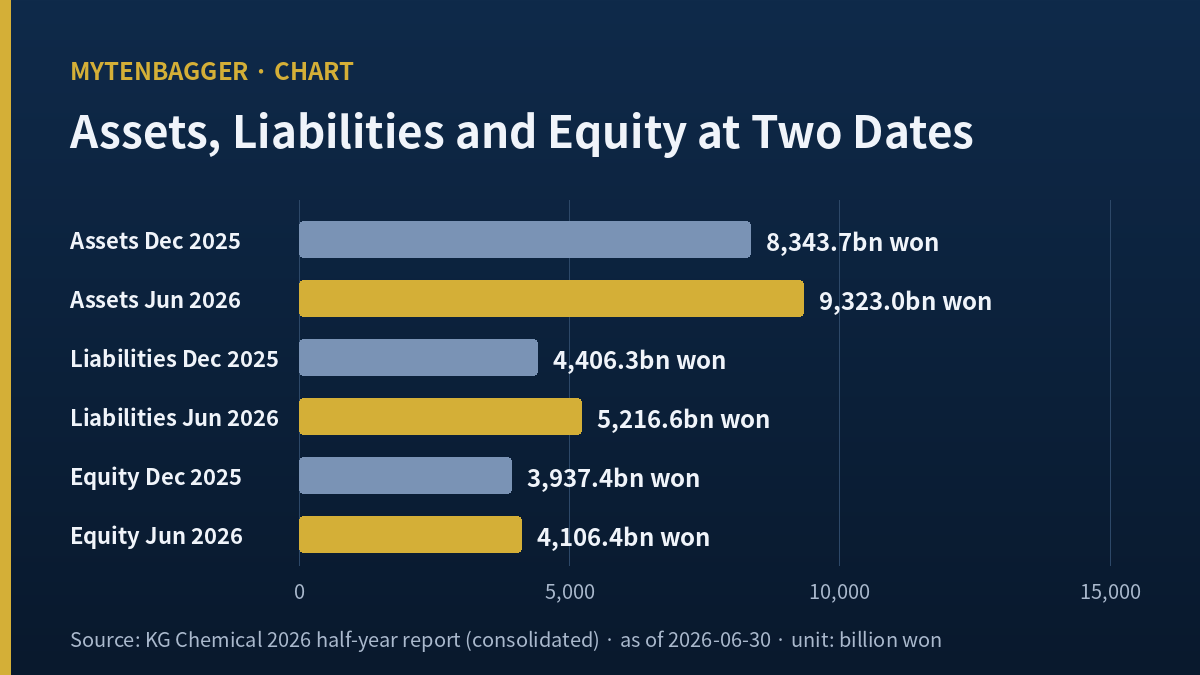
| Item (billion won) | Dec 2025 | Jun 2026 | Change |
|---|---|---|---|
| Total assets | 8,343.7 | 9,323.0 | +979.3 |
| Current assets | 3,383.7 | 4,414.8 | +1,031.1 |
| Cash and equivalents | 363.5 | 650.9 | +287.4 |
| Total liabilities | 4,406.3 | 5,216.6 | +810.3 |
| Total equity (assets less liabilities) | 3,937.4 | 4,106.4 | +169.0 |
| Owners of the parent | 999.0 | 1,049.8 | +50.8 |
Source: Valueline Korea statement of financial position, retrieved September 23, 2026. Total equity is my own subtraction of liabilities from assets; the source lists the other lines directly. Figures converted from the source’s 100-million-won units.
Assets grew 11.74 percent in six months and liabilities grew 18.39 percent. Equity grew 4.29 percent. Cash grew 79.07 percent, from 363.5 to 650.9 billion won. Every one of those four percentages is mine, calculated from the two dated columns above.
Here is the part I keep returning to. The cash line alone, 650.9 billion won, is more than twice the 279.9 billion won the market assigns to the whole company. That comparison has obvious limits, and I will get to them. But it is the background against which a 100,000-share purchase has to be read.
The short-dated side of the KG Chemical stock balance sheet
Current assets finished June 2026 at 4,414.8 billion won against current liabilities of 3,908.8 billion won. Dividing gives 112.94 percent. At December 2025 the same two lines were 3,383.7 and 3,069.5 billion won, or 110.24 percent. Both figures are mine; neither site gives that division.
So the short-dated cushion widened slightly over the six months, by 2.70 percentage points, while current assets grew 1,031.1 billion won and current liabilities grew 839.3 billion won. A group holding a carmaker and a steel maker inside it carries inventory and receivables that move with volume, so I would not read either number as a liquidity signal on its own. What I take from it is narrower: nothing in the six-month movement looks like a company under pressure to conserve, which is the condition under which a paused shareholder-return policy would explain itself.
There is a second reading of the same six months that I owe the page. Liabilities grew by 810.3 billion won while equity grew by 169.0 billion won, so roughly five-sixths of the asset growth arrived as borrowing and not as retained result. That is not unusual for a group whose operating units carry trade payables, and it is not a solvency observation. But it does mean the balance sheet got larger mostly by taking on obligations, and a company in that posture has a defensible reason to keep a payout formula unsettled for a while longer.
I hold that reading and my own at the same time, and I am not going to pretend one cancels the other. What I will not do is write the second one as though the company had offered it. It has not. Nobody at this issuer has said that borrowing growth is why the policy is still under review; I constructed that explanation out of two dated columns, and it is mine.
I have run into the shape of this before, in a food company that published revenue for seven markets and profit for none of them. There the gap sat inside a table. Here it sits between two filings. Either way the discipline is to mark the hole and leave it marked.
The sentence about pressure to conserve is the one I want on the record, because it is the closest thing this article has to a verdict. If the balance sheet had tightened, I would read the missing refiling as prudence. It did not tighten, so I am left without that explanation and without any other one.
Why the KG Chemical stock cash comparison is weaker than it looks
The cash sits on a consolidated statement. This company does not own all of what its statements pull in, and the parent’s slice of total equity is 1,049.8 billion won out of 4,106.4 billion won. Cash held inside a subsidiary is not cash the parent can simply direct, and a group with a carmaker and a steel maker inside it has operating reasons to hold working capital that a holding-company screen will never show.
I have written about the gap between a consolidated result and what reaches the parent before, in a piece on a cathode maker whose minority holders took most of the group result, and I am deliberately not making that the spine of this one. It is a real caveat and it is not my thesis.
The one number I trust most here
Share registers survive disclosure gaps better than almost anything else on a Korean filing. I can confirm 66,403,636 shares outstanding two ways: an aggregator states it directly, and the market value a second site gives divides back to the close I adopted, to the won.
The weaker leg of that claim is the close itself. Three price sites showed three different values for the same September 23 session while I was reading. I adopted the one whose market-value field divided back, to the won, against 66,403,636 shares; the other two divided back to the prior session instead. That is a judgment, and it is the kind of judgment that would quietly move every percentage in this article if I got it wrong.
So when I say the June purchase was 0.1506 percent of the company and the September grant moved the controlling stake by 0.0135 percentage points, those are not estimates drifting on someone’s screen. They come from integers the company itself disclosed. That is why this article is built on the share register and not on a multiple.
What I checked and left out
I could not obtain the purchase consideration for the June buying, so I have not put a won amount on it. I could not confirm whether the 66,403,636 figure excludes a preferred line, because one Korean data site gives 67.23 million shares issued. I left the dividend per share out of the body for the same reason: without a settled share number, a total payout figure would be a guess wearing a decimal point.
Sell-side coverage: none found
There is no analyst valuation in this piece because I could not find one. An earnings aggregator states on its own page that no consensus estimate exists for this issuer. Two Korean research portals were unreachable. I did not decide there was no coverage; a data provider wrote that on its screen and I copied the sentence. No brokerage per-share number appears here, and neither does one from the company.
A US-listed name I borrowed, and nothing else
Loews Corporation (NYSE: L) is the American name I reached for, and I want to be exact about why. I did not choose it on industry or size. I chose it because it is a listed company whose name matches none of the businesses it actually owns, which is the structural feature that makes this Korean issuer hard to read from a single line item. I did not open Loews’s filings for this piece. I am borrowing the category and nothing else, and no number of theirs appears anywhere here. A reader should not treat that name as support for any claim I make.
Nine things that cut against me on KG Chemical stock
- A missing filing is not a broken promise. The company wrote “or at the point specifics are settled.” If specifics are not settled, the second clause is still running and nothing has lapsed.
- My search was secondary. I could not reach the exchange’s disclosure viewer. A refiling could exist that my sources never carried.
- The buying was real. Whatever the policy status, the company spent money on its own shares in June, and a sister affiliate did the same. Actions outrank statements.
- 0.0135 percentage points is not control creep. A group already above 56 percent does not need 8,976 shares. Reading intent into that move would be reading too much.
- Insider compensation in shares is normal. Paying people in stock aligns them with the share price. I am describing the mechanics and alleging nothing.
- Six months of balance-sheet growth is not deterioration. Liabilities grew faster than equity, but assets and cash both grew, and the company was not shrinking.
- The cash comparison overstates the case. Cash inside the group is not parent cash. I said so above and I am repeating it here because it is the weakest link in my reading.
- I could not open a single primary document. Every figure in this article arrived through an aggregator or a news outlet, most of them Korean-language.
- My whole angle rests on the absence of something. Absence is the hardest thing to prove and the easiest to be wrong about, and if that filing turns up, the first half of this article is worth nothing.
Seven conditions that would change what I do
- A refiling appears with the policy settled. Then the question stops being about process and starts being about the payout formula.
- The formula names its numerator. Whether returns are set against the group result or the parent’s slice changes the size of the promise by a factor, given the parent holds about a quarter of total equity.
- The remaining 91,024 shares are retired. Retirement is the version of a buyback that cannot be undone by a later grant.
- Further open-market buying is disclosed at a size that matters. Something an order of magnitude above 0.1506 percent would read as a program and not as a gesture.
- The Q3 report, due by November 16, 2026, shows liabilities growing faster than assets again. Two consecutive periods would make the six-month pattern a direction.
- Cash falls back toward the December 2025 level. The 650.9 billion won figure is what makes the market value look odd; if it halves, the oddity goes with it.
- The preferred-share question is settled. If the right number of shares turns out to be 67.23 million and not 66,403,636, every percentage in this article moves.
Two of the seven deserve a note on how I would judge them. Retirement, the third condition, is the only one of the capital actions available here that cannot be reversed by a later decision; a purchase can be followed by a grant, as June was followed by September, but a retired share does not come back. And the sixth condition, cash falling toward the prior level, is deliberately written against my own reading: I put the 650.9 billion won figure at the center of why this market value looks strange, so I am obliged to say what would take it off the table.
Three of those seven, the last three, can be answered by one document with a known date. The other four have no date at all, and that gap between what has a date on it and what does not is the whole shape of this position. I am comfortable waiting because the dated ones come first.
How I read the gap in KG Chemical stock disclosure
A company that discloses a self-imposed date is telling you something useful whether or not it meets it. Meeting it is information. Not meeting it is also information, and the second kind is usually harder to find because nothing gets published when nothing happens.
In this case the missing thing is a document and not a line in a table, but the useful move is the same one: name precisely what is absent and do not fill the space with an estimate.
Where I stand today, and what I wrote down
A deadline is not something I used to write down. When a company said it would come back with more detail, I filed that as a soft intention and moved on to the numbers, because the numbers felt like the real work and the sentence about timing felt like packaging. This is the first time I have built a whole reading around one of those sentences, and what changed my mind was noticing that the date was the only part of the June filing that could ever be checked. Everything else in it was a statement about a state of mind. The date was a fact with a future in it.
There is a smaller lesson inside that one. A sentence about timing is the only part of a corporate statement that has a testable future in it, and I had been treating it as the disposable part. So the practice I am keeping is this: when an issuer sets its own date, I write the date down in my own file the day I read it, and I go back on that date myself, without waiting for the news to tell me something did not happen.
One more thing about scale, for readers who do not follow this market. KOSPI names outside the top tier get very thin research attention, and a Korean group structure puts several operating businesses under one listed parent whose own name describes only the smallest of them. That combination is why a company with a trillion-won-plus balance sheet can trade at a market value smaller than a single line on it without anyone writing a note about it. It is also why a self-imposed filing date carries more weight here than it would for a covered large cap: there is no analyst to ask the question on my behalf.
I hold no position and I have entered no order. If the refiling appears and names its numerator, I will open this company again with an actual formula in hand and I will say so in the piece that follows. If the Q3 report lands on November 16, 2026 with still nothing filed on the policy, I will keep waiting and I will not treat the June buying as a substitute for it.
Prices and market value reflect the September 23, 2026 close. The US dollar figure is approximate, converted at roughly 1,358.4 won per dollar, the Seoul market close on the same date.
Related reading
- Isu Chemical Balance Sheet: Liabilities Down, Equity Up
- Hansol Chemical 2026 Earnings Forecast Has No Analyst Behind It
- Sajo Daerim Dividend Yield 0.90% as Its Largest Holder Buys
- Hyundai Elevator Dividend After a 20-Year Shareholder Dispute